Electric Car that is.
If you ever doubted the effect of political resolve in the direction of the US energy just look at the very recent and profound changes I'm seeing with the current Obama Administration and it's current "Stimulus" monies floating around.
In the span of a month electric cars and infrastructure went from a P.R. play thing for electrical utilities to an audacious effort by Oregon's Governor. Last week I started hearing rumblings of a big effort out of Oregon Department of Energy. It seems to be moving big in this direction with the announcement of a 500 recharging station goal in the next two years. More to the point is that in Oregon the cost looks like it will be under $2,000 to field your own recharging station with the grants, tax credits and other offerings in Oregon's planning.
Wired Magazine covered Shai Agassi's vision for an electric car infrastructure. It's talked about, glowingly received, brainstormed, and then just kind of out there. Add a few billion dollars of Federal political resolve and BOOOOM! The electric car is a reality.
Now lets just see if Tesla, Chevy, and Nissan can deliver their electric cars.
I am really intrigued and interested. I have a few friends who have been betting big on electric power-trains, battery controls, and importing foreign I.P. around this sphere. Before last week I never really thought about the market potential for electric infrastructure. Specifically recharging station.
That has now changed!
My gears have really been spinning about how this market development will need to take place and I'm fascinated. In particular how do you charge for the refill of the vehicle (which current technology will likely take 2 hours). You have a capital cost to recoup, the variable electric bill to charge for, the space (which takes hours per customer), and of course how do you scale a regional, national, or international system so an electric car owning fleet can recharge simply in NYC, LA, or PDX regardless?
This moves the business model away from just electric recharging stations (on a real scale) to be a business model that fits with a traditional regional petroleum jobber. Those wadding away from one-off customers to a wide deployment are now wadding into my waters.
Its really got me thinking about the future of the markets I serve and its an exciting subject. It really reminds me of dealing with early supply issues of Biodiesel and Ethanol. Where those without any fleet supply experience were trying to build businesses without any context or understanding of their market's needs.
Its going to be fun over this summer.
Showing posts with label Battery Technology. Show all posts
Showing posts with label Battery Technology. Show all posts
Saturday, March 28, 2009


Tuesday, February 17, 2009
Algea from city waste. A common idea actually going forward.
In biofuels there are few unique ideas. What really constitutes a breakthrough (much like artistic projects) isn't the concept but finding a patron to move a project from the drawing board to demonstration.
Reuters UK reports a Dutch experiment going forward. Dutch biotechnology firm Ingrepro is the project developer moving waste streams into biomass.
"The waste of biomethane (biogas) plants has very rich nutrients left over. At the moment they just pump it to the river or throw it away -- but we say next to these biomethane plants you need to build algal ponds to grow biomass."
What I like about this is the co-locate with an existing methane recovery program. The fact that you already have an existing successful energy project sweetens the deal. In a future where CO2 off-set projects are going to be looking for easy to utilize methane to capture I see this as a nifty model to move algae projects forward as well.
So if the capital costs of a algae project are covered by an existing methane project with experienced technical staff capable of managing an algal operation that only leaves the cash value of monetizing the algae biomass. Ingrepro claims their market will be jet fuel.
Reuters UK reports a Dutch experiment going forward. Dutch biotechnology firm Ingrepro is the project developer moving waste streams into biomass.
"The waste of biomethane (biogas) plants has very rich nutrients left over. At the moment they just pump it to the river or throw it away -- but we say next to these biomethane plants you need to build algal ponds to grow biomass."
What I like about this is the co-locate with an existing methane recovery program. The fact that you already have an existing successful energy project sweetens the deal. In a future where CO2 off-set projects are going to be looking for easy to utilize methane to capture I see this as a nifty model to move algae projects forward as well.
So if the capital costs of a algae project are covered by an existing methane project with experienced technical staff capable of managing an algal operation that only leaves the cash value of monetizing the algae biomass. Ingrepro claims their market will be jet fuel.
Tuesday, September 23, 2008
A Man, His Business Model, and a Paradigm Shifting Approach to the Electric Car.
 From Wired Magazine. An interesting and thought provoking idea coming our way from Israel (a nation no doubt distinctly aware of where their economy's petro purchase dollars flow).
 Here is the story in a nutshell. The issue with electric cars in the short term is a full large-scale deployment of support. Not just complete with recharging stations but also battery swap out facilities if you need a fully charged battery on short notice for a longer range trip. Also critical is support of fully delveloped and existing auto manufacturers to support electric vehicles. (See diagram below)

So in essence its the story of the Hydrogen Car but with technology immediately available today, full OEM support to roll out electric cars, and a product horizon of the near future.
Its doable and no less audacious than any other major idea drawing investment, support, and political advertising photo-ops right now. Its a little more complex than T. Boone Pickens' concept of converting vehicles to natural gas (an easy process) and much simpler than a Hydrogen Economy concept talked by the do-nothing till next decade crowd in opposition to most other proposals.
As viable as the smart-grid ideas pitched as the future, hydrogen refueling concepts pushing for funding, and of course the next-Gen biofuels emerging right now. I like what I'm hearing and I think that its something that would likely draw funding and support. In particular if Government and Utility groups stepped up to support this concept like they've done other experimental technologies in the past.
Also worth note, an Agassi quote from the article:
"I thought that the greatest problem of our time was oil. Oil on one hand is polluting the land, and on the other hand it's financing terror."
I trust those who are motivated by a perspective that moves them outside the normal box of concept. I don't trust those who are thinking big concepts to make a billion dollars. Though its a nice goal it breaks the focus away from true success of the technology and the recipricol partnerships necessary for a billion dollar business to thrive.
I am a capitalist personally so I don't trust those motivated that government is the sole solution either. But I do find an amazing pool of ideas and concpets trickling up from the End of Suburbia entrapanuer set. I don't believe in peak oil but I do find common ground with the perspective that imagines a world without oil and attempts to develop solutions that in their own right could compete with petroleum.
Shai Agassi is a leader of a logical framework I hope to see more from. An architect for the future that right or wrong will probably wring real additional wealth and value from technologies already with us and never applied in new directions. This is the definition of progress. Ideas pushing envelopes.
NOTE: I use this blog primarily to organize my reading, thoughts, and reactions over time. Complete with the tags and other background links. This is a little less than timely but I wanted to ensure I had it up for sake of finding it again.
Monday, September 22, 2008
Oh How they Forget
Sawdust a.k.a. "Biomass" was a common heating and boiler fuel in the Pacific NW. Very common. You can see the remnants of these hoppers and belt systems attached like skeletal remains on older buildings. They exist all over the older parts of Oregon. Which makes the following story reasonably funny.
From this week's Wallowa Chieftan Article:
"On Friday, Sept. 19, the first-ever biomass boiler system to be installed in an Oregon School District will be the subject of a much-anticipated gathering at Enterprise High School. The ribbon-cutting, dedication and tour of the facility will take place from 1 to 3 p.m., and the public is invited to attend."
Its funny when high-tech is really the fuel of yester-year with the additional controls of a computer aided combustion and recirculated exhaust gas improving the efficiency and emissions of the fuel. But of course the argument would be - it's new to them.
From this week's Wallowa Chieftan Article:
"On Friday, Sept. 19, the first-ever biomass boiler system to be installed in an Oregon School District will be the subject of a much-anticipated gathering at Enterprise High School. The ribbon-cutting, dedication and tour of the facility will take place from 1 to 3 p.m., and the public is invited to attend."
Its funny when high-tech is really the fuel of yester-year with the additional controls of a computer aided combustion and recirculated exhaust gas improving the efficiency and emissions of the fuel. But of course the argument would be - it's new to them.
Thursday, July 31, 2008
Gizmodo Solar Posts Worth Reading
I bounced over to Gizmodo and saw some interesting mentions.

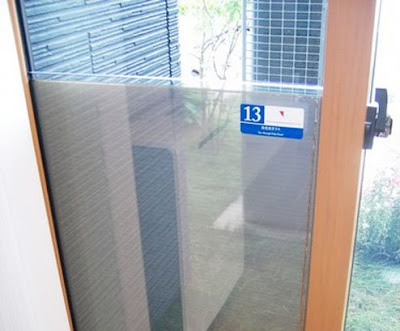 Tranluscent solar panel windows. The above isn't the most cost effective technology today but the concept has been talked about for as long as I've been aware of solar panels. So prior to my ability to type this ideas been floated around as the future of solar. Cool to see in reality. I'm sure their are installs off the grid where this makes perfect sense though.
The above is an apparatus that stores solar power into a fuel cell system. It would allow a more efficient storage sink for power than your standard inefficient battery. This idea is not a new one but being it looks like a marketable product moving to production. That being actually being worth mention as a new twist (an elegant idea making it to market).
Tranluscent solar panel windows. The above isn't the most cost effective technology today but the concept has been talked about for as long as I've been aware of solar panels. So prior to my ability to type this ideas been floated around as the future of solar. Cool to see in reality. I'm sure their are installs off the grid where this makes perfect sense though.Monday, June 23, 2008
McCain Proposes Federal "X-Prize" for Electric Battery Powertrain Vehicles
John McCain goes all Portland, Oregon on the campaign trail. (See BizJournal for more info or JohnMcCain.com for the actual press release).
This seriously sounds like a left-coast proposal right along with the X-Prize for cars. The real question is why $300 million, why not other prizes, and what business does the Federal government have in offering a prize?
John McCain Will Propose A $300 Million Prize To Improve Battery Technology For Full Commercial Development Of Plug-In Hybrid And Full Electric Automobiles.
A $300 million prize should be awarded for the development of a battery package that has the size, capacity, cost and power to leapfrog the commercially available plug-in hybrids or electric cars. That battery should deliver a power source at 30 percent of the current costs. At $300 million, the prize is one dollar for every man, woman and child in this country -- and a small price to pay for breaking our dependence on oil.
I guess as long as it doesn't benefit a sitting special interest group John McCain can throw out pork with a straight face like the rest of them.
Having participated in a few government Request for Proposal (RFP) processes in the past I really don't see this making real sense in practice. Though on the stump it obviously has some real positive ring to it.
What I do like about it is the trust that if given incentive the free market will provide the solutions. Of course, when the Feds offer the prize instead of the free market it sorta destroys the logic of this effect though.
This seriously sounds like a left-coast proposal right along with the X-Prize for cars. The real question is why $300 million, why not other prizes, and what business does the Federal government have in offering a prize?
John McCain Will Propose A $300 Million Prize To Improve Battery Technology For Full Commercial Development Of Plug-In Hybrid And Full Electric Automobiles.
A $300 million prize should be awarded for the development of a battery package that has the size, capacity, cost and power to leapfrog the commercially available plug-in hybrids or electric cars. That battery should deliver a power source at 30 percent of the current costs. At $300 million, the prize is one dollar for every man, woman and child in this country -- and a small price to pay for breaking our dependence on oil.
I guess as long as it doesn't benefit a sitting special interest group John McCain can throw out pork with a straight face like the rest of them.
Having participated in a few government Request for Proposal (RFP) processes in the past I really don't see this making real sense in practice. Though on the stump it obviously has some real positive ring to it.
What I do like about it is the trust that if given incentive the free market will provide the solutions. Of course, when the Feds offer the prize instead of the free market it sorta destroys the logic of this effect though.
Subscribe to:
Posts (Atom)