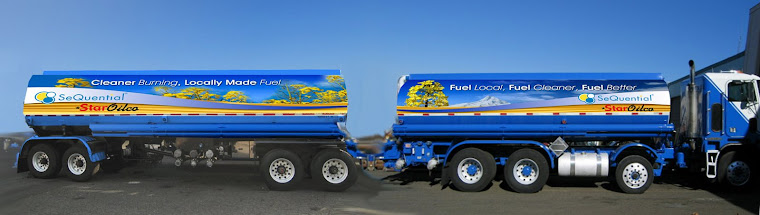
Today I got a call from Energy Today Magazine about our business. In checking into their online addition I came across a few good articles. One in particular goes in depth to the process of capturing and developing oil sands in Alberta, Canada.
An excerpt from Cooperation Needed by Brent Sangster:
The mining and extraction process made a dramatic technological leap in the 1980s when it converted from dragline and bucket wheels to hydraulic and electric shovels that load the raw material (e.g., sand, clay, bitumen) on to massive trucks that today have a capacity of 400 tons.
These trucks transport the material to a crusher, where it is slurried with water before being transported via pipeline to an extraction plant. New technology is being tested here to move the crushing and slurrying operations right to the mine face, eliminating trucks or at least significantly reducing hauling distances.At the extraction plant, the bitumen is isolated from the water, sand, and clay (known as tailings), which are pumped into large containment ponds for settling and eventual reuse. Some unrecovered bitumen and naptha finds its way into these ponds as well.
Tailings ponds are designed to reclaim both the water and the area itself as a natural habitat. But the silts in the mixture can take many years to settle, during which time nearby water sources must be safeguarded from contamination and the ponds must be monitored to ensure wildlife is not exposed.
Technological issues here focus on ways to increase the speed of silt settling, such as using chemical thickeners or centrifuges to separate the silt from the water. Other needed advancements include technologies to remove the residual bitumen, recover valuable minerals such as zircon, and polish the water for re-use.
Just something I thought might be worth finding again.
Showing posts with label News. Show all posts
Showing posts with label News. Show all posts
Thursday, February 25, 2010


Saturday, January 2, 2010
Thorium the Green Nuke Fuel
This months Wired has an interesting story on Thorium as a "green" replacement for uranium as a nuclear fuel.
Given the future of the world will be lowCO2 with no emmissions if possible Nuclear power is going to have to be a good portion of our energy portfolio. Anything that helps with this debate is good.
I'm curious to see if shortly politicians start using the word "thorium" to sound smart similarly as they would use "clean coal" a decade ago.
Sunday, June 7, 2009
Trolling bout Biodiesel
I saw a new press event for Propel Biofuels on the Biobased News site.
It seems like its been years since I've heard about Propel. I remember a few years ago they were poised to move forward boldly. Infused with V.C. cash and processing something more than that (a company chalked full of people filled with ability). They also had an awesome grasp of where to take the biofuel market to and therefore a compelling pitch to go with their business.
But after spending several hundred's of thousands of dollars building the best biodiesel infrastructure around Seattle their expectations didn't materialize. Of course nobody's expectations in the field did either. Now they are back pulling earned media and I like what I see.
Why do I like it? One self indulgent reason. Its the same argument and effort that I am making in Portland. I think they are correct except they are failing to see the real value in their business and intellectual property (which I will keep to myself). Its good to see your own logic and marketing packaging elsewhere.
It seems like its been years since I've heard about Propel. I remember a few years ago they were poised to move forward boldly. Infused with V.C. cash and processing something more than that (a company chalked full of people filled with ability). They also had an awesome grasp of where to take the biofuel market to and therefore a compelling pitch to go with their business.
But after spending several hundred's of thousands of dollars building the best biodiesel infrastructure around Seattle their expectations didn't materialize. Of course nobody's expectations in the field did either. Now they are back pulling earned media and I like what I see.
Why do I like it? One self indulgent reason. Its the same argument and effort that I am making in Portland. I think they are correct except they are failing to see the real value in their business and intellectual property (which I will keep to myself). Its good to see your own logic and marketing packaging elsewhere.
Tuesday, May 5, 2009
OPIS Newsflash on Land Use Impacts of Biofuels
Well its a better argument than the one's we faced with Food vs. Fuel. Its logical and seems to be more results oriented. Hopefully this is a fair debate that moves us beyond the bullet-statement and bumper sticker arguments around ethanol.
From OPISnet.com
BIOFUEL GROUPS CONTINUE TO OPPOSE INDIRECT LAND USE INCLUSION IN RFS
Industry sources continued this afternoon to sift through the voluminous 1,004-page notice of proposed rulemaking for the expanded renewable fuels standard (RFS) that U.S. EPA issued this morning, but it appears as though while biofuel advocates appreciate the establishment of the Biofuels Interagency Working Group, they still oppose EPA's inclusion of indirect land use (ILUC) in the agency's establishment of lifecycle greenhouse gas emissions.
As passed under the 2007 energy bill, the 36-billion gal/yr RFS is broken into four segments: a capped corn-based ethanol requirement of 15 billion gallons by 2015; 21 billion gallons of the overall mandate contains "advanced biofuels" by 2022, with 16 billion gallons of that amount, under the same timeframe, from cellulosic biofuel. For the fourth carve-out, up to 1 billion gallons by 2012 is required to be from biomass-based diesel.
Meanwhile, conventional biofuels would be required to emit 20% fewer lifecycle greenhouse gas emissions (GHG) compared to gasoline, while "advanced biofuels" would be required to emit 50% fewer lifecycle greenhouse gas emissions and cellulosic biofuel would be required to emit 60% fewer emissions.
In this morning's notice of proposed rulemaking, EPA included emissions from ILUC in its lifecycle requirements, much to the chagrin of the biofuels industry. Biofuel groups, agricultural academics and some lawmakers had asked EPA to delay the ILUC requirements until there was a generally accepted method for determining the regulation.
"If you look at the direct impact of ethanol, from the production of the grain to transportation to the facility to the process of making the ethanol to transporting that to market, there are significant benefits to ethanol over petroleum," about 61% lower than petroleum fuels on average, said Renewable Fuels Association President Bob Dinneen, speaking on a conference call with reporters earlier today. However, "there is so much uncertainty" when trying to factor indirect effects, he said.
Additionally, the proposed ILUC requirements are not being uniformly applied, since there is no similar provision for petroleum production, Dinneen noted. "You'll see no international indirect effect of petroleum applied. EPA should've looked at this when they were creating the baseline. They are willing to count the number of angels on the head of pin for biofuels, [and] they ought to give more than just a cursory look at petroleum production," he said.
But Dinneen said he was pleased EPA would specifically be soliciting scientific feedback and peer review on the ILUC proposal.
Similar comment came from other biofuel groups, including Growth Energy, POET, the American Coalition for Ethanol (ACE), Biotechnology Industry Association and Brazilian sugarcane trade association UNICA.
"As evidenced by the recent debate over the low carbon fuel standard in California, biofuels are greatly penalized by these preliminary calculations,"
said UNICA Chief Representative in North America Joel Velasco. "We know sugarcane ethanol has the lowest carbon emissions of any liquid biofuel produced today. California recognized as much in its low carbon fuel standard.
We are certain that when the EPA considers the best available data and research, these indirect land use effects from sugarcane cultivation in Brazil will be marginal at best," he added.
Meanwhile, the National Biodiesel Board said that a final EPA rule on indirect land use changes "that is based on questionable science and is structured in a manner that restricts the role of sustainable vegetable oils in the program will make it nearly impossible to meet the Advanced Biofuels goals established by statute," according to NBB Vice President of Federal Affairs Manning Feraci. "Hopefully, common sense will prevail in this process and the EPA will issue a workable final rule that is based on sound science and allows the U.S. biodiesel industry to make a positive contribution to the RFS2 program," he added.
Brian Jennings, executive vice president of ACE, said he was pleased that USDA Secretary Tom Vilsack will be co-chairing the Biofuels Interagency Working Group along with the heads of DOE and EPA. "I think this means ethanol remains at the table for the president's energy policies moving forward, despite the political desire of some to box ethanol out. I think the working group will ensure that fossil fuels are finally examined along with biofuels in these LCA [land use change] assessments," he added.
The Natural Resources Defense Council (NRDC), meanwhile, is pleased with the inclusion of the indirect land use provision. "We must develop biofuels the smart way, and we are encouraged that EPA Administrator Jackson has offered a science-based proposal to get this done," said NRDC's Nathanael Greene. "The opportunity to review EPA's proposal will help ensure that developing biofuels won't mean using our most fragile forests for fuel and that biofuels provide real benefits. We plan to submit comments on what EPA has gotten right and what must be improved to make sure the outcome serves our environmental and energy needs," he added.
While both the American Petroleum Institute and the National Petrochemical & Refiners Association were still reviewing the proposal, they are concerned with the availability of biofuels that will be needed under the RFS. "While NPRA looks forward to commenting more specifically on the proposed guidelines, the questions of commercial viability, product liability and the lack of adequate scientific review with regard to mandated increased quantities of ethanol remain unresolved," said NPRA President Charles Drevna. The association said it trusts "that EPA will seriously and transparently consider the concerns raised by fuel, public health, environmental, and engine manufacturing interests as it proceeds toward finalizing guidelines for RFS implementation."
Similarly, API spokesman Karen Matusic said it is "surprised and disappointed" that EPA, in relying on industry information, believes there are sufficient plans underway to build plants capable of producing 100 million gal of cellulosic ethanol in 2010 and are therefore not proposing to waive the requirement for next year. "The waiver criteria is not 'plans to build,' but is 'projected volumes of cellulosic biofuels production," she noted. "Information readily available to the government clearly shows that very little cellulosic biofuels will be produced in 2010," she added.
Meanwhile, anticipating that ILUC would, in fact, be included in EPA's proposed rule, U.S. Sen. John Thune (R-S.D.) introduced legislation last week that would direct EPA to only focus on the direct lifecycle greenhouse gas emissions in its regulation. Speaking on the conference call this morning, Dinneen said these and other congressional efforts are separate from EPA's peer review efforts and aren't likely to be withdrawn.
Once EPA's proposal is published in the Federal Register, the agency will begin to accept public comments for 60 days. Meanwhile, EPA plans to hold a workshop on June 10-11 at the Dupont Hotel in Washington, D.C., to present details of the lifecycle GHG analysis included in the proposal.
For more information on the proposal, visit:
http://www.epa.gov/otaq/renewablefuels/index.htm#regulations.
--Robert Gough, OPISnet
--Rachel Gantz, OPISnet
From OPISnet.com
BIOFUEL GROUPS CONTINUE TO OPPOSE INDIRECT LAND USE INCLUSION IN RFS
Industry sources continued this afternoon to sift through the voluminous 1,004-page notice of proposed rulemaking for the expanded renewable fuels standard (RFS) that U.S. EPA issued this morning, but it appears as though while biofuel advocates appreciate the establishment of the Biofuels Interagency Working Group, they still oppose EPA's inclusion of indirect land use (ILUC) in the agency's establishment of lifecycle greenhouse gas emissions.
As passed under the 2007 energy bill, the 36-billion gal/yr RFS is broken into four segments: a capped corn-based ethanol requirement of 15 billion gallons by 2015; 21 billion gallons of the overall mandate contains "advanced biofuels" by 2022, with 16 billion gallons of that amount, under the same timeframe, from cellulosic biofuel. For the fourth carve-out, up to 1 billion gallons by 2012 is required to be from biomass-based diesel.
Meanwhile, conventional biofuels would be required to emit 20% fewer lifecycle greenhouse gas emissions (GHG) compared to gasoline, while "advanced biofuels" would be required to emit 50% fewer lifecycle greenhouse gas emissions and cellulosic biofuel would be required to emit 60% fewer emissions.
In this morning's notice of proposed rulemaking, EPA included emissions from ILUC in its lifecycle requirements, much to the chagrin of the biofuels industry. Biofuel groups, agricultural academics and some lawmakers had asked EPA to delay the ILUC requirements until there was a generally accepted method for determining the regulation.
"If you look at the direct impact of ethanol, from the production of the grain to transportation to the facility to the process of making the ethanol to transporting that to market, there are significant benefits to ethanol over petroleum," about 61% lower than petroleum fuels on average, said Renewable Fuels Association President Bob Dinneen, speaking on a conference call with reporters earlier today. However, "there is so much uncertainty" when trying to factor indirect effects, he said.
Additionally, the proposed ILUC requirements are not being uniformly applied, since there is no similar provision for petroleum production, Dinneen noted. "You'll see no international indirect effect of petroleum applied. EPA should've looked at this when they were creating the baseline. They are willing to count the number of angels on the head of pin for biofuels, [and] they ought to give more than just a cursory look at petroleum production," he said.
But Dinneen said he was pleased EPA would specifically be soliciting scientific feedback and peer review on the ILUC proposal.
Similar comment came from other biofuel groups, including Growth Energy, POET, the American Coalition for Ethanol (ACE), Biotechnology Industry Association and Brazilian sugarcane trade association UNICA.
"As evidenced by the recent debate over the low carbon fuel standard in California, biofuels are greatly penalized by these preliminary calculations,"
said UNICA Chief Representative in North America Joel Velasco. "We know sugarcane ethanol has the lowest carbon emissions of any liquid biofuel produced today. California recognized as much in its low carbon fuel standard.
We are certain that when the EPA considers the best available data and research, these indirect land use effects from sugarcane cultivation in Brazil will be marginal at best," he added.
Meanwhile, the National Biodiesel Board said that a final EPA rule on indirect land use changes "that is based on questionable science and is structured in a manner that restricts the role of sustainable vegetable oils in the program will make it nearly impossible to meet the Advanced Biofuels goals established by statute," according to NBB Vice President of Federal Affairs Manning Feraci. "Hopefully, common sense will prevail in this process and the EPA will issue a workable final rule that is based on sound science and allows the U.S. biodiesel industry to make a positive contribution to the RFS2 program," he added.
Brian Jennings, executive vice president of ACE, said he was pleased that USDA Secretary Tom Vilsack will be co-chairing the Biofuels Interagency Working Group along with the heads of DOE and EPA. "I think this means ethanol remains at the table for the president's energy policies moving forward, despite the political desire of some to box ethanol out. I think the working group will ensure that fossil fuels are finally examined along with biofuels in these LCA [land use change] assessments," he added.
The Natural Resources Defense Council (NRDC), meanwhile, is pleased with the inclusion of the indirect land use provision. "We must develop biofuels the smart way, and we are encouraged that EPA Administrator Jackson has offered a science-based proposal to get this done," said NRDC's Nathanael Greene. "The opportunity to review EPA's proposal will help ensure that developing biofuels won't mean using our most fragile forests for fuel and that biofuels provide real benefits. We plan to submit comments on what EPA has gotten right and what must be improved to make sure the outcome serves our environmental and energy needs," he added.
While both the American Petroleum Institute and the National Petrochemical & Refiners Association were still reviewing the proposal, they are concerned with the availability of biofuels that will be needed under the RFS. "While NPRA looks forward to commenting more specifically on the proposed guidelines, the questions of commercial viability, product liability and the lack of adequate scientific review with regard to mandated increased quantities of ethanol remain unresolved," said NPRA President Charles Drevna. The association said it trusts "that EPA will seriously and transparently consider the concerns raised by fuel, public health, environmental, and engine manufacturing interests as it proceeds toward finalizing guidelines for RFS implementation."
Similarly, API spokesman Karen Matusic said it is "surprised and disappointed" that EPA, in relying on industry information, believes there are sufficient plans underway to build plants capable of producing 100 million gal of cellulosic ethanol in 2010 and are therefore not proposing to waive the requirement for next year. "The waiver criteria is not 'plans to build,' but is 'projected volumes of cellulosic biofuels production," she noted. "Information readily available to the government clearly shows that very little cellulosic biofuels will be produced in 2010," she added.
Meanwhile, anticipating that ILUC would, in fact, be included in EPA's proposed rule, U.S. Sen. John Thune (R-S.D.) introduced legislation last week that would direct EPA to only focus on the direct lifecycle greenhouse gas emissions in its regulation. Speaking on the conference call this morning, Dinneen said these and other congressional efforts are separate from EPA's peer review efforts and aren't likely to be withdrawn.
Once EPA's proposal is published in the Federal Register, the agency will begin to accept public comments for 60 days. Meanwhile, EPA plans to hold a workshop on June 10-11 at the Dupont Hotel in Washington, D.C., to present details of the lifecycle GHG analysis included in the proposal.
For more information on the proposal, visit:
http://www.epa.gov/otaq/renewablefuels/index.htm#regulations.
--Robert Gough, OPISnet
--Rachel Gantz, OPISnet
Monday, April 13, 2009
VW Golf - World Car of the Year

The 2010 Golf is named "World Car of the Year" by a panel of journalist and auto industry folks.
The real good news in the story I saw at Wired.com though. Its coming to the US in diesel. Now the only issue will be whether or not it can handle a blend of biodiesel higher than B20. The latest clean diesel VW's have an oil dilution issue with higher blends of biodiesel. It occurs where the particulate trap on the vehicles must maintain a temperature to burn out particulate. With B99 biodiesel it doesn't fully burn all of the fuel in the particulate trap depositing this residual fuel into the oil pan of the vehicle. This dilution should not cause issues with the actual wear on the engine if the fuel is ASTM spec (this according to a presentation I saw from a VW engineer discussing their engines). The issue becomes engine lights go off requiring an oil change between 2,000 and 3,000 miles (as the oil pan fills up over capacity).
I saw it first in a recent issue of Biodiesel Smarter magazine (a insiders type zine dedicated to sustainable biodiesel news). By far the best biodiesel trade magazine you will ever find. Dedicated to B100 and B99 market development.
I'm curious to see how the industry deals with this. My bet (and this is a bad thing) biodiesel enthusiasts will just disconnect their particulate trap. This creating a conflict not just with OEM's and biodiesel users but also the EPA and local regulators.
Sunday, April 12, 2009
OPEC wants cheap oil.... Hmmmm?
Saw the analysis at MSNBC online from a month ago. Not exactly timely but something jumped out at me that will alter my perception of what the future might hold.
OPEC tried on Sunday to nudge oil prices up by urging its members to stop overproducing, but the cartel decided not to cut current output levels which could have driven prices sharply higher. Explaining the decision, OPEC Secretary-General Abdalla el-Badri spoke of his organization's concern over "ugly" global economic times that overrode the desire to achieve a quick fix by setting a lower overall output for the 12-nation producer's club.
First off, I'm thoroughly entertained that a roughly $50 a barrel and $2+ gasoline is considered "Cheap" by today's standards. Two years ago it was not.
I know. Everyone got used to a $200 barrel of crude being a realistic price. Regardless, I remember making biodiesel and ethanol pitches back when diesel was expensive at $0.75/a gallon and being told that no one would ever buy a biofuel unless it was cheaper. And oil would never trade wholesale above $1 a gallon.
I remember one time on-road diesel with taxes hit $1.28 and customers called to complain wanting to know "HOW" it was possible that prices could swing so high (it was caused by a sudden shutting down of the Olympic Pipeline into Portland by regulators because of safety issues).
My how we've changed our definitions and expectations. Me included (I get really nostalgic at times for a high price of oil being $15 a barrel back when I started at StarOilco).
Oh how life was easier in the oil business when I was empowered with an Economics degree and so much certainty. But enough of the simple past - the future has much more potential and a greater opportunity with those with open minds and strong backs.
Also add to this that OPEC likely has not forgotten that this is not "cheap" but a dream-boat of oil pricing and acceptability. If the harshest international recession of the last 80 years leaves the bottom of the market at $50 barrel of crude they will be very happy with this new economic picture for oil.
This is the real point of my post. Calibrate your instruments. $50 is the new floor for the foreseeable future. If the price of a barrel of oil starts trading below this number there is a change in the economic numbers that set prices.
If I was a practicing economist I would try to set up an experiment to determine volumes of ethanol, biodiesel, renewable diesel, syn diesel, and other fuel volumes as they effect over all pricing of petroleum. It would be fun to try and create an easy factor of volumes of substitutes (even if they trade at a surplus cost) and their effect on petroleum prices.
Given the US's energy position in the world not only as a consumer but market that sets prices you would likely be able to just use EPA and DOE numbers to run such an experiment. I would treat the measurements much like the Federal Reserve tracks the money supply. With an E1 for only petroleum refined products sold, E2 including immediate blendable substitutes including mandated blends, and an E3 and E4 for moving to wider industrial substitutes such as hog fuel, and experimental fuels manufactured outside of the main streams of commerce.
There has been very little talk about this (other than by the ethanol industry). To me this is the future of the debate. If only I could simultaneously work and be an academic. Ahh, the dream. Being able to actual focus on the bigger picture without the requirement of betting correctly with your own money.
Monday, March 2, 2009
EPA and RIN's Clearing House
OPISnet reports a turn of events around RINs (so did a recent RINstar webinar).
It looks like the EPA will be creating (or at least proposing) their own RIN clearing house. We don't know what this clearing house will look like but of course I'm pretty pessimistic. Guaranteed it will be brought to the industry by the same folks who invented the DMV. Hopefully I'm being a little over dramatic but that's just my gut instinct.
My initial thoughts on this was that you can tell the Obama Administration would be abandoning the market based approaches of the last eight years. Good for CPA's bad for the industry is my prediction.
It looks like the EPA will be creating (or at least proposing) their own RIN clearing house. We don't know what this clearing house will look like but of course I'm pretty pessimistic. Guaranteed it will be brought to the industry by the same folks who invented the DMV. Hopefully I'm being a little over dramatic but that's just my gut instinct.
My initial thoughts on this was that you can tell the Obama Administration would be abandoning the market based approaches of the last eight years. Good for CPA's bad for the industry is my prediction.
Sunday, March 1, 2009
Future Fuel TV
About a year ago a TV crew from SyndiKast came to Portland to cover the retail biodiesel market in our city. Their project was called Future Fuel TV and the finished product was really good.
They also created a video which I think is a real good time-specific look at what Portland's biodiesel market was like a few years ago. Right before Portland's B5 mandate and the optomistic growth of voluntary adopters.
SyndiKast covers the gamut of biofuels and alternative energy. They produced the segments to be good stock footage as well as a good primer on the subject.
You can see SyndiKast website on biodiesel (I don't believe they have the finished video up currently).
They also created a video which I think is a real good time-specific look at what Portland's biodiesel market was like a few years ago. Right before Portland's B5 mandate and the optomistic growth of voluntary adopters.
SyndiKast covers the gamut of biofuels and alternative energy. They produced the segments to be good stock footage as well as a good primer on the subject.
You can see SyndiKast website on biodiesel (I don't believe they have the finished video up currently).
Tuesday, February 17, 2009
Cascade Grains Files for Chapter 11 Protection
Its been a rough few months for the ethanol industry. First with falling commodity pricing washing away the protective assumptions of a hedged position. Then a recession reduced fuel consumption further reducing not only the price of gasoline but the mandate blend usages expected in Oregon.
To compound this Cascade Grain also shipped some product with (from what I've been told second hand) ASTM spec fuel that exceeding a sulfate content that threw the ethanol out of specification use by a major refinery selling E10 gasoline to retail users. This same (less than reliable rumor) source told me that the cause was the well water used in the manufacture of the product which had sulfur in it to begin with .
(NOTE: I have no idea if the above is true this is all second hand information that sounded plausible enough to post. If incorrect I will gladly pull this down and apologize).
This being reported in far less detail as part of the Chapter 11 story in the following news papers.
See it in the Portland Business Journal, Seattle Post Intelligence, an AP mention in the Oregonian (where I first saw the story this morning) and the local community to the plant the Longview Daily News
The best reporting on the subject is the local Longview Daily News. I recomend reading that first.
To compound this Cascade Grain also shipped some product with (from what I've been told second hand) ASTM spec fuel that exceeding a sulfate content that threw the ethanol out of specification use by a major refinery selling E10 gasoline to retail users. This same (less than reliable rumor) source told me that the cause was the well water used in the manufacture of the product which had sulfur in it to begin with .
(NOTE: I have no idea if the above is true this is all second hand information that sounded plausible enough to post. If incorrect I will gladly pull this down and apologize).
This being reported in far less detail as part of the Chapter 11 story in the following news papers.
See it in the Portland Business Journal, Seattle Post Intelligence, an AP mention in the Oregonian (where I first saw the story this morning) and the local community to the plant the Longview Daily News
The best reporting on the subject is the local Longview Daily News. I recomend reading that first.
Sunday, January 18, 2009
The Babe Ruth of Soy Beans and a Story of Competitve Corn Growing

I've been meaning to put this Wired Magazine article up for over a month.
Here is a great story talking about real industrialized commercial agriculture. Its rare that you get a lay person's article about mono-culture agriculture and what they are wrestling with. The perspective touched on here is one worth reading.
Especially looking at the every expanding productivity of US soil, seeds, chemicals, manpower and on the ground intellect that is our mainstream agriculture.
One excerpt that really gets to the heart of the new development of GMO crops that caught my eye is below.
Cullers never went to college, but he rises at 3:30 each morning to study plant genetics online. Right now, he's urging Pioneer to genetically weave a bit of stiffening fiber into soybean stalks. Cullers plants 300,000 soybeans per acre, double the national average. In these super-dense fields, he explains, soy plants grow taller, fighting for sunlight. "They fall down a lot," he says, "and you lose photosynthesis. The trifoliates don't pump nutrients to the beans. And you get disease, too. It's crowded and humid out there, down low."
Something about it reminds me more about the development of a race car with experience in the Pit rather than the further development of an agricultural crop. This is obviously engineering with a specificity reserved up till now for mechanical systems not organisms.
NOTE: To those who are adamant and hostile to GMO. I understand, I've seen and read both sides of this debate in depth for years. Being on the sidelines and outside of the issue I am an agricultural agnostic. I do buy certified organic and local food as a rule as well. Please don't flame me just because I gave ink to what I view as a relevant article.
Monday, January 5, 2009
Whole Energy in the News
My Google Alerts shot back an interesting article. Reading it I see one thing at play. Atul and my friends at Whole Energy have walked head first into a political hornets nest.
"They always try to put it on consent," said Mark Stechbart, outspoken biodiesel plant critic. "They hijacked a 12-year-old environmental impact report to gloss over the issues. I don't think Whole Energy has the finances to do this. The city is buying into a real bad fiscal situation. If they believe this is a legitimate thing to do, they should have known about this months ago and had a full public hearing. It's another midnight, last-minute (Mayor Jim) Vreeland deal."
It looks like there are powerful players in this project rooting for their failure in an effort to take political swipes an the Mayor responsible for getting their project into place. I know talking with Atul and Kevin from Whole Energy this project is a huge opportunity and a ripe project. They describe the facility and the community as the best opportunity they've seen. I wish them luck. The west coast will need more product and I know the bay area is very interested in waste stream biodiesel.
Tuesday, September 30, 2008
Dark Humor in the Ethanol Industry
Give this analyst an award for most colorful description of VeraSun Energy's financial condition:
"Last week, ethanol producer VeraSun Energy (VSE) announced it put itself up for sale after blowing its brains out in the corn market."
The article came from SeekingAlpha.com
"Last week, ethanol producer VeraSun Energy (VSE) announced it put itself up for sale after blowing its brains out in the corn market."
The article came from SeekingAlpha.com
Tuesday, September 23, 2008
A Man, His Business Model, and a Paradigm Shifting Approach to the Electric Car.
 From Wired Magazine. An interesting and thought provoking idea coming our way from Israel (a nation no doubt distinctly aware of where their economy's petro purchase dollars flow).
 Here is the story in a nutshell. The issue with electric cars in the short term is a full large-scale deployment of support. Not just complete with recharging stations but also battery swap out facilities if you need a fully charged battery on short notice for a longer range trip. Also critical is support of fully delveloped and existing auto manufacturers to support electric vehicles. (See diagram below)

So in essence its the story of the Hydrogen Car but with technology immediately available today, full OEM support to roll out electric cars, and a product horizon of the near future.
Its doable and no less audacious than any other major idea drawing investment, support, and political advertising photo-ops right now. Its a little more complex than T. Boone Pickens' concept of converting vehicles to natural gas (an easy process) and much simpler than a Hydrogen Economy concept talked by the do-nothing till next decade crowd in opposition to most other proposals.
As viable as the smart-grid ideas pitched as the future, hydrogen refueling concepts pushing for funding, and of course the next-Gen biofuels emerging right now. I like what I'm hearing and I think that its something that would likely draw funding and support. In particular if Government and Utility groups stepped up to support this concept like they've done other experimental technologies in the past.
Also worth note, an Agassi quote from the article:
"I thought that the greatest problem of our time was oil. Oil on one hand is polluting the land, and on the other hand it's financing terror."
I trust those who are motivated by a perspective that moves them outside the normal box of concept. I don't trust those who are thinking big concepts to make a billion dollars. Though its a nice goal it breaks the focus away from true success of the technology and the recipricol partnerships necessary for a billion dollar business to thrive.
I am a capitalist personally so I don't trust those motivated that government is the sole solution either. But I do find an amazing pool of ideas and concpets trickling up from the End of Suburbia entrapanuer set. I don't believe in peak oil but I do find common ground with the perspective that imagines a world without oil and attempts to develop solutions that in their own right could compete with petroleum.
Shai Agassi is a leader of a logical framework I hope to see more from. An architect for the future that right or wrong will probably wring real additional wealth and value from technologies already with us and never applied in new directions. This is the definition of progress. Ideas pushing envelopes.
NOTE: I use this blog primarily to organize my reading, thoughts, and reactions over time. Complete with the tags and other background links. This is a little less than timely but I wanted to ensure I had it up for sake of finding it again.
Sunday, September 21, 2008
The sign read: "This is Not a Concept Car"
The return of the VW Turbo Diesel.

Hybrid mpg efficiency with Century Old technology. Thank you Rudolf Diesel and thank you VW for the long awaited return.
I was driving past a VW dealership in Salem, Oregon and what did I see? A vinyl covered new VW Jetta TDI which said along its panels "45 mpg This is Not a Concept Car."
I've been waiting and now it looks like its finally about to arrive. Now lets just hope that Honda, Toyota, Subaru, GM and Ford all follow through with their own suggestions of small sedan clean diesels. I could only imagine what a Subaru AWD wagon would do for Biodiesel if it rolled out with a high efficiency clean diesel engine.
Now the only question is..... Will it be for under $25,000?
Tuesday, September 16, 2008
Google and Distributive Wave Power

This is interesting. Google has not taken its success for granted and has invested its historically unique opportunity to move many great ideas forward. This one leads the pack in my opinion. The paring of one technology with a whole business model. I could really see this providing some strong reliable technology to many lesser developed nations. An interesting concept to say the least.
I saw it first at a favorite E-Newsletter of mine the Environmental Leader
"The floating data centers would be located 3 to 7 miles from shore, in 50 to 70 meters of water. If perfected, this approach could be used to build 40 megawatt data centers that don’t require real estate or property taxes."
The E-Leader cites Data Center Knowledge as their source with a more in depth discussion of Google's plans to make containerized data centers.
Friday, July 25, 2008
Biodiesel and Warranty
After quite a bit of work Nikola Davidson and the Northwest Biofuels Association pulled off policy for biodiesel with the new car dealers here in Oregon. Good job on Nikola's part. Any progress is good.

Please find attached a joint letter from the Oregon Auto Dealers and the Northwest Biofuels Association regarding biodiesel warranty protocol for auto dealers. This letter was created in close collaboration with Oregon biodiesel distributors and the hope is to replicate this in other states (tailoring it to reflect the needs of those members).
The next step will be distributing this letter to all the Oregon auto dealers. The letter is also available to download from NWBA's website: http://www.nwbiofuels.org/biofuel-resources-biodiesel-engine-warranties
This has taken longer than expected but I think having the auto dealer association's buy-off is worth the wait. Thanks for your input and support - Nikola
Nikola H. L. Davidson
DirectorNorthwest Biofuels Association
206.389.8660
www.nwbiofuels.org

Please find attached a joint letter from the Oregon Auto Dealers and the Northwest Biofuels Association regarding biodiesel warranty protocol for auto dealers. This letter was created in close collaboration with Oregon biodiesel distributors and the hope is to replicate this in other states (tailoring it to reflect the needs of those members).
The next step will be distributing this letter to all the Oregon auto dealers. The letter is also available to download from NWBA's website: http://www.nwbiofuels.org/biofuel-resources-biodiesel-engine-warranties
This has taken longer than expected but I think having the auto dealer association's buy-off is worth the wait. Thanks for your input and support - Nikola
Nikola H. L. Davidson
DirectorNorthwest Biofuels Association
206.389.8660
www.nwbiofuels.org
Monday, July 21, 2008
Ethanol Industry Responds to OPEC

OPEC's members and official spokespersons have been claiming publicly for a few month now that ethanol was partially to blame for high crude oil prices. The ethanol industry has responded to these claims from the oil producing nations by taking out an advertisement explaining their perspective (ad shown above).
That perspective being simple. Ethanol increases and extends petroleum supplies and that existence in the market place puts a downward pressure on petroleum prices. Additionally (my words not theirs) its my impression that the Ethanol Producers are also implying that ethanol will soon be a real competitor for petroleum worldwide offering choice.
I saw the initial story at the Biobased News and followed it over to the RFA's Press Release.
The groups –- the Canadian Renewable Fuels Association (CRFA), the European Bioethanol Fuel Associations, the Brazilian Sugarcane and Ethanol Industry Association (UNICA) and the US Renewable Fuels Association – were answering the charges by OPEC that ethanol was in part responsible for the soaring price of crude oil, a price that will fetch OPEC nations more than $1.2 trillion dollars this year alone.
Also worth noting is the advertisement's citing of the Merrill Lynch study which claims that ethanol's effect on prices is downward. As without ethanol the world's petroleum producers would need to produce one million additional barrels of crude a day. The price effect of ethanol in the marketplace is believed to reduce overall crude prices as much as 15% according to the Merrill Lynch report.
Tuesday, July 15, 2008
GM Supports the Expansion of E85 Pumps

GM has recently become a champion for ethanol in the US. Not just a positive PR when its useful type supporter of biofuels but a full on advocate. Most recently I just saw a news report from Bloomberg where GM and the National Governor's Association will work together to get an expansion of available E85 pumps throughout 15 US states.
This is more than just talk from GM its actual market development. They aren't just developing E85 flex fuel vehicles they are also making lower cost and domestically made ethanol a real option for consumers attracted to their vehicles.
Tuesday, July 8, 2008
Jatropha Comes to the US

This is the first US agricultural story about Jatropha I've ever seen where farmers where actually growing it commercially. I will be interested to follow this as farming in the US can get very political.
At this years Sustainable Biodiesel Summit in Florida the very prominent biodiesel expert Dr. Shaine Tyson had some very strong words to say about Jatropha being a poisonous and dangerous crop. That any biofuel crop which didn't provide more food along with energy was a bad policy decision.

From Orlando TV News WESH
LA BELLE, Fla. -- For drivers in Hendry County, expensive gas prices may no longer be a problem.
Residents of the small county in southwest Florida have turned to a farm to grow their own oil to survive the difficult economic times.
"We wanted to find a solution to a problem in the U.S.," said Mark Dalton, owner of Dream Fuel, LLC. "With the rising demand of fuel worldwide, we wanted to create our own fuel."
Farms in La Belle have been busy growing Jatropha trees. Jatropha is widely considered the newest and greatest source of biofuel. The tiny trees produce small, green fruit which contains the vital oil-bearing seeds.
"It's grown in Brazil, China, India, Guatemala, Africa," Dalton said. "In many places all over the country, we're behind in producing Jatropha oil."
Many see potential in Jatropha's ability to stave off the high demand for oil, but it would take an exorbitant amount of plants to make a dent in the worldwide economy.
"It basically takes 20 pounds of seed to make one gallon of Jatropha oil," Dalton said. "So, you would have to grow quite a bit of it."
Farmers especially have been hurt by high gas prices.
"We have tractors that sometimes go through 120 gallons of fuel a day," said La Belle farmer Byran Beer.
On the verge of a recession, farmers need any help they can get. Now, Jatropha can be grown, processed and used in the tractors.
"Hopefully, with technology and enough people's inputs, this thing will really turn into something," Beer said.
To produce the alternative fuel, Jatropha plants require a tropical climate to flourish, such as the one found in southwest Florida. Farmers in Hendry County have planted nearly 1 million Jatropha trees, Dalton said.
"We're seeing good results," he added, "but there's still a lot of unknowns."
At this years Sustainable Biodiesel Summit in Florida the very prominent biodiesel expert Dr. Shaine Tyson had some very strong words to say about Jatropha being a poisonous and dangerous crop. That any biofuel crop which didn't provide more food along with energy was a bad policy decision.
From Orlando TV News WESH
LA BELLE, Fla. -- For drivers in Hendry County, expensive gas prices may no longer be a problem.
Residents of the small county in southwest Florida have turned to a farm to grow their own oil to survive the difficult economic times.
"We wanted to find a solution to a problem in the U.S.," said Mark Dalton, owner of Dream Fuel, LLC. "With the rising demand of fuel worldwide, we wanted to create our own fuel."
Farms in La Belle have been busy growing Jatropha trees. Jatropha is widely considered the newest and greatest source of biofuel. The tiny trees produce small, green fruit which contains the vital oil-bearing seeds.
"It's grown in Brazil, China, India, Guatemala, Africa," Dalton said. "In many places all over the country, we're behind in producing Jatropha oil."
Many see potential in Jatropha's ability to stave off the high demand for oil, but it would take an exorbitant amount of plants to make a dent in the worldwide economy.
"It basically takes 20 pounds of seed to make one gallon of Jatropha oil," Dalton said. "So, you would have to grow quite a bit of it."
Farmers especially have been hurt by high gas prices.
"We have tractors that sometimes go through 120 gallons of fuel a day," said La Belle farmer Byran Beer.
On the verge of a recession, farmers need any help they can get. Now, Jatropha can be grown, processed and used in the tractors.
"Hopefully, with technology and enough people's inputs, this thing will really turn into something," Beer said.
To produce the alternative fuel, Jatropha plants require a tropical climate to flourish, such as the one found in southwest Florida. Farmers in Hendry County have planted nearly 1 million Jatropha trees, Dalton said.
"We're seeing good results," he added, "but there's still a lot of unknowns."
Monday, June 30, 2008
FTC Ruling on Biodiesel and other Renewable Diesel Fuels
I came across a document that I thought was interesting. Rather than save to my desktop I figured this blog would be a better place to save the file.
The Federal Trade Commission promulgated a rule around the labeling and standard for biodiesel and "biomassed based diesels" (a description I have never formally heard referred to before).
Biomass-based Diesel Defined From the Rule Making:
Biomass-based diesel means a diesel fuel substitute produced from nonpetroleum renewable
resources that meets the registration requirements for fuels and fuel additives established by the Environmental Protection Agency under 42 U.S.C. 7545, and includes fuel derived from animal wastes, including poultry fats and poultry wastes, and other waste materials, or from municipal solid waste and sludges and oils derived from wastewater and the treatment of wastewater, except that the term does not include biodiesel as defined in this Part.
This is significant for two reasons. One, I never knew that the FTC had any part in the labeling or distribution of fuels. Second, this is the rule I recently saw mentioned by a PMAA newsletter about new biodiesel labeling requirements.
See the rule making here.
The Federal Trade Commission promulgated a rule around the labeling and standard for biodiesel and "biomassed based diesels" (a description I have never formally heard referred to before).
Biomass-based Diesel Defined From the Rule Making:
Biomass-based diesel means a diesel fuel substitute produced from nonpetroleum renewable
resources that meets the registration requirements for fuels and fuel additives established by the Environmental Protection Agency under 42 U.S.C. 7545, and includes fuel derived from animal wastes, including poultry fats and poultry wastes, and other waste materials, or from municipal solid waste and sludges and oils derived from wastewater and the treatment of wastewater, except that the term does not include biodiesel as defined in this Part.
This is significant for two reasons. One, I never knew that the FTC had any part in the labeling or distribution of fuels. Second, this is the rule I recently saw mentioned by a PMAA newsletter about new biodiesel labeling requirements.
See the rule making here.
Subscribe to:
Posts (Atom)