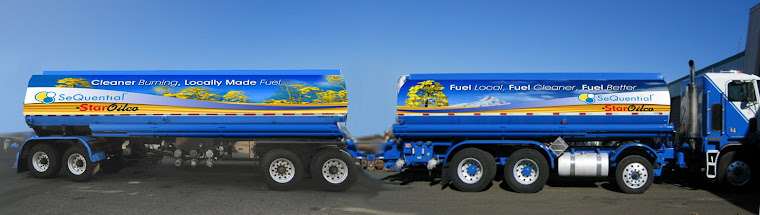
Univ. of Idaho has a great new biodiesel blog. Gotta love it.
Check it out HERE!
Showing posts with label Biodiesel. Show all posts
Showing posts with label Biodiesel. Show all posts
Thursday, November 11, 2010


Tuesday, June 8, 2010
Oregon's BETC Reform
In energy circles Oregon has been well known in the last ten years for it's generous Business Energy Tax Credit (BETC) which offers up to 50% off the capital cost of a project back as an income tax deduction. Better yet if you are a low cash flow start up you can "Pass-Through" this BETC for 35% of face value cash up front. So if you build a $1,000,000 project in theory Oregon will give you a $500,000 income tax break over five years and you can sell this tax break to an investor for $350,000 cash.
Its no doubt one of the greatest deals for project development out there. Throw into that mix a huge clean energy consumer base and utility connection to wheel power to the California market and you've got a strong comparative advantage in Oregon. I know I've done several project that would not have happened without the BETC which have directly created jobs at my family's business. I've also used the BETC as a down payment with a bank as part of financing. Its a great economic development tool but the lack of boundaries on the program has blown up its use. Solar panel manufacturers, wind farm developers, and a few large projects have exploded the dollar figure this tax credit brings.
So in Oregon the Department of Energy (ODOE) has been under fire for the Business Energy Tax Credit taking a large cash draw in the economic downturn. The fact that the alternative energy tax break is primarily being taken by the Wal-Mart, large banks, and other huge corporations hasn't polished its image any either. Corporate welfare is never a great selling point. This causing Oregon's Legislature to push a "reform" to bring down the total dollar figure of the BETC.
I've always thought the controversy of corporations taking BETC's to avoid income tax is over stated. In fact its safe to say if it wasn't for the BETC many of these companies wouldn't have realized the same amount of income tax (then avoided by a BETC) by creative and legal accounting gimmicks to minimize profits in Oregon. I am very confident that the BETC funnels what otherwise would have been money leaving Oregon into capital investments that raise local property taxes far in excess of their real cost to Oregon's general fund.
Now back to the actual reform. One good thing is they moved the one year BETC opportunity up to a $20,000 one year project (meaning I can take a tax credit in one year instead of taking it over five years). Short payback of tax credits is very good for small businesses seeing great years and investing in improving their operation. In the small business community you never know what the next year holds so five year paybacks are a tough sell for a BETC. Better yet, one year is very positive for the type of projects I do with refueling infrastructure which can be kept under $20,000 if we work at it. It's also very good for retrofit projects as well so local smaller scale contractors will benefit from this.
As of right now there is a cap of $300 million in BETC money established through 2011's state budget. Of this $300 million $218 million potential projects has already been pre-certified. So in theory its already spent. But of course it probably won't be close to spent. It begs the question, how does this work that projects take years and are unpredictable and therefore when the BETC vests to being taken might effect other budget years?
There is a Q&A page but it hasn't posted any questions and answers. I definitely have small talk to make next time I run into an ODOE staffer. Just that much more reason to get to local conferences I guess.
To help they have created a "tiered" approach. ODOE shows an under $500,000 project costs, $500,000 to $6,000,000 project cost, and of course an upward of $6,000,000 project. This will be interesting. It does not mention how they will break out the remaining sum of cash between these projects. I also am curious what happens if you apply pre-project, don't get a pre-certification, then start building and finish in a specific time frame. If other's in that tier didn't finish can you take their budget allotment?
Oh well. As with all changes questions and ideas pop up.
Its no doubt one of the greatest deals for project development out there. Throw into that mix a huge clean energy consumer base and utility connection to wheel power to the California market and you've got a strong comparative advantage in Oregon. I know I've done several project that would not have happened without the BETC which have directly created jobs at my family's business. I've also used the BETC as a down payment with a bank as part of financing. Its a great economic development tool but the lack of boundaries on the program has blown up its use. Solar panel manufacturers, wind farm developers, and a few large projects have exploded the dollar figure this tax credit brings.
So in Oregon the Department of Energy (ODOE) has been under fire for the Business Energy Tax Credit taking a large cash draw in the economic downturn. The fact that the alternative energy tax break is primarily being taken by the Wal-Mart, large banks, and other huge corporations hasn't polished its image any either. Corporate welfare is never a great selling point. This causing Oregon's Legislature to push a "reform" to bring down the total dollar figure of the BETC.
First a law capping total dollars came down. Then rules were written to figure out how to stay within the budget. So the rules are set and now is the time to pay attention as any potential new project I may come across will be playing in this new league. Through the recession I haven't had much in the way of project opportunity. Just trying to keep momentum moving forward for what we built pre-2008. Taking a look there are things I agree with and those I don't.
First I don't see any reference to property tax impact of a capital project (and I didn't in the debate during the reform). The local positive impact of these projects isn't considered at all. If the state is losing on the income tax side but funneling more in a much more permanent base of property tax revenues I would call that great policy. Unfortunately the only focus isn't on long term revenues but instead on a single ticket price
I've always thought the controversy of corporations taking BETC's to avoid income tax is over stated. In fact its safe to say if it wasn't for the BETC many of these companies wouldn't have realized the same amount of income tax (then avoided by a BETC) by creative and legal accounting gimmicks to minimize profits in Oregon. I am very confident that the BETC funnels what otherwise would have been money leaving Oregon into capital investments that raise local property taxes far in excess of their real cost to Oregon's general fund.
Now back to the actual reform. One good thing is they moved the one year BETC opportunity up to a $20,000 one year project (meaning I can take a tax credit in one year instead of taking it over five years). Short payback of tax credits is very good for small businesses seeing great years and investing in improving their operation. In the small business community you never know what the next year holds so five year paybacks are a tough sell for a BETC. Better yet, one year is very positive for the type of projects I do with refueling infrastructure which can be kept under $20,000 if we work at it. It's also very good for retrofit projects as well so local smaller scale contractors will benefit from this.
As of right now there is a cap of $300 million in BETC money established through 2011's state budget. Of this $300 million $218 million potential projects has already been pre-certified. So in theory its already spent. But of course it probably won't be close to spent. It begs the question, how does this work that projects take years and are unpredictable and therefore when the BETC vests to being taken might effect other budget years?
There is a Q&A page but it hasn't posted any questions and answers. I definitely have small talk to make next time I run into an ODOE staffer. Just that much more reason to get to local conferences I guess.
To help they have created a "tiered" approach. ODOE shows an under $500,000 project costs, $500,000 to $6,000,000 project cost, and of course an upward of $6,000,000 project. This will be interesting. It does not mention how they will break out the remaining sum of cash between these projects. I also am curious what happens if you apply pre-project, don't get a pre-certification, then start building and finish in a specific time frame. If other's in that tier didn't finish can you take their budget allotment?
Oh well. As with all changes questions and ideas pop up.
Sunday, June 7, 2009
Trolling bout Biodiesel
I saw a new press event for Propel Biofuels on the Biobased News site.
It seems like its been years since I've heard about Propel. I remember a few years ago they were poised to move forward boldly. Infused with V.C. cash and processing something more than that (a company chalked full of people filled with ability). They also had an awesome grasp of where to take the biofuel market to and therefore a compelling pitch to go with their business.
But after spending several hundred's of thousands of dollars building the best biodiesel infrastructure around Seattle their expectations didn't materialize. Of course nobody's expectations in the field did either. Now they are back pulling earned media and I like what I see.
Why do I like it? One self indulgent reason. Its the same argument and effort that I am making in Portland. I think they are correct except they are failing to see the real value in their business and intellectual property (which I will keep to myself). Its good to see your own logic and marketing packaging elsewhere.
Thursday, April 23, 2009
Oregon Startup makes Biobased News
Diesel Brewing hits the biz wire.
I've never heard of this start up before but I'm intrigued. In particular butanol has a real promise to be used in biodiesel production as well as a gasoline blend stock. As it relates to biodiesel the butanol can be used as the alcohol in the transesterfication process.
Primarily methanol is the alcohol used. When butanol is used supposedly the gel point of the biodiesel drops significantly below 0 degrees.
Their formal website is http://www.dieselbrewing.com/
I neither endorse or am familiar with anyone associated with Diesel Brewing. I just saw the news and thought it interesting.
Monday, April 13, 2009
VW Golf - World Car of the Year

The 2010 Golf is named "World Car of the Year" by a panel of journalist and auto industry folks.
The real good news in the story I saw at Wired.com though. Its coming to the US in diesel. Now the only issue will be whether or not it can handle a blend of biodiesel higher than B20. The latest clean diesel VW's have an oil dilution issue with higher blends of biodiesel. It occurs where the particulate trap on the vehicles must maintain a temperature to burn out particulate. With B99 biodiesel it doesn't fully burn all of the fuel in the particulate trap depositing this residual fuel into the oil pan of the vehicle. This dilution should not cause issues with the actual wear on the engine if the fuel is ASTM spec (this according to a presentation I saw from a VW engineer discussing their engines). The issue becomes engine lights go off requiring an oil change between 2,000 and 3,000 miles (as the oil pan fills up over capacity).
I saw it first in a recent issue of Biodiesel Smarter magazine (a insiders type zine dedicated to sustainable biodiesel news). By far the best biodiesel trade magazine you will ever find. Dedicated to B100 and B99 market development.
I'm curious to see how the industry deals with this. My bet (and this is a bad thing) biodiesel enthusiasts will just disconnect their particulate trap. This creating a conflict not just with OEM's and biodiesel users but also the EPA and local regulators.
Sunday, March 1, 2009
Future Fuel TV
About a year ago a TV crew from SyndiKast came to Portland to cover the retail biodiesel market in our city. Their project was called Future Fuel TV and the finished product was really good.
They also created a video which I think is a real good time-specific look at what Portland's biodiesel market was like a few years ago. Right before Portland's B5 mandate and the optomistic growth of voluntary adopters.
SyndiKast covers the gamut of biofuels and alternative energy. They produced the segments to be good stock footage as well as a good primer on the subject.
You can see SyndiKast website on biodiesel (I don't believe they have the finished video up currently).
Wednesday, February 18, 2009
Purdue's Library of Sustainable Energy
Purdue University Extension has put together and launched a website on "Renewable Energy" which showcases a great collection of information.
I really liked was the collection of simple and easy to read information. Purdue seems to even give Wikipedia a run for its money on some subjects. I really like the platform of PDF's and whoever put this together did an awesome job.
If you are doing research on the subject it provides a great resource in one place. I would rank this collection of information up there with the Oregon Environmental Council and Northwest Biofuels Association similar efforts. One difference though. Purdue covers new ground.
I don't agree 100% with what I've read so far. Regardless, Purdue's website is worth the bookmark!
Monday, January 5, 2009
Whole Energy in the News
My Google Alerts shot back an interesting article. Reading it I see one thing at play. Atul and my friends at Whole Energy have walked head first into a political hornets nest.
"They always try to put it on consent," said Mark Stechbart, outspoken biodiesel plant critic. "They hijacked a 12-year-old environmental impact report to gloss over the issues. I don't think Whole Energy has the finances to do this. The city is buying into a real bad fiscal situation. If they believe this is a legitimate thing to do, they should have known about this months ago and had a full public hearing. It's another midnight, last-minute (Mayor Jim) Vreeland deal."
It looks like there are powerful players in this project rooting for their failure in an effort to take political swipes an the Mayor responsible for getting their project into place. I know talking with Atul and Kevin from Whole Energy this project is a huge opportunity and a ripe project. They describe the facility and the community as the best opportunity they've seen. I wish them luck. The west coast will need more product and I know the bay area is very interested in waste stream biodiesel.
Tuesday, December 2, 2008
The Future of Algea - Off-Take Production

The future of algae is finding someone willing to pay you to play with it.
I've talked to dozens of start-up entrepreneurs with dreams of phytoplankton business. All these business models with the hopes of developing a new crude oil for the next century. The "crude dreams" of oil production from an endless uber-productive super-algae that would feed the humanity protein as well as feed our insatiable vehicles carbohydrates distilled into ethanol and fats reacted into biodiesel.
The big issue though. How do you pay for the capital cost of a algae bio-reactor? The device that will take water, light, CO2 and make the bugs into an industrial input. Will angels and VC pay for the magical devices that will make algal goo. This goo in turn being cut, distilled, processed, reacted and made into the endless variety of products that we currently source from petroleum.
Deep pockets in this market though are tough to come by. What is now looking apparent is the need for someone already paying to deal with algea. A current cost stream begging for a better solution.
One such industry is commercial fish farms. To that end I came across a recent article that caught my eye. Though this is not a unique idea its still one to watch. What makes it innovative is the fact that the technology might actually work. In the word of biofuels technical talk is cheap and demonstration is worth millions in Federal funding.
From an article from Greenbang.com:
Under PetroSun’s BioFuels Aquaculture Lease Programme, participating farm operators would receive a rent incentive and monthly royalties in return for access to their pond algae. In future, farmers could also gain additional benefits from a carbon credit program, the company said.PetroSun (a leader in algae technology in the US) has announced what I would call an interesting and very viable business model. To co-locate with fish farms that have an algae maintenance concern. Instead of these farms paying the internal cost to deal with algal growth they will get a return for partnering with PetroSun to create value from the biological reality association with commercial aquaculture.
Friday, July 25, 2008
Biodiesel and Warranty
After quite a bit of work Nikola Davidson and the Northwest Biofuels Association pulled off policy for biodiesel with the new car dealers here in Oregon. Good job on Nikola's part. Any progress is good.

Please find attached a joint letter from the Oregon Auto Dealers and the Northwest Biofuels Association regarding biodiesel warranty protocol for auto dealers. This letter was created in close collaboration with Oregon biodiesel distributors and the hope is to replicate this in other states (tailoring it to reflect the needs of those members).
The next step will be distributing this letter to all the Oregon auto dealers. The letter is also available to download from NWBA's website: http://www.nwbiofuels.org/biofuel-resources-biodiesel-engine-warranties
This has taken longer than expected but I think having the auto dealer association's buy-off is worth the wait. Thanks for your input and support - Nikola
Nikola H. L. Davidson
DirectorNorthwest Biofuels Association
206.389.8660
www.nwbiofuels.org
Tuesday, July 8, 2008
Jatropha Comes to the US

This is the first US agricultural story about Jatropha I've ever seen where farmers where actually growing it commercially. I will be interested to follow this as farming in the US can get very political.
At this years Sustainable Biodiesel Summit in Florida the very prominent biodiesel expert Dr. Shaine Tyson had some very strong words to say about Jatropha being a poisonous and dangerous crop. That any biofuel crop which didn't provide more food along with energy was a bad policy decision.

From Orlando TV News WESH
LA BELLE, Fla. -- For drivers in Hendry County, expensive gas prices may no longer be a problem.
Residents of the small county in southwest Florida have turned to a farm to grow their own oil to survive the difficult economic times.
"We wanted to find a solution to a problem in the U.S.," said Mark Dalton, owner of Dream Fuel, LLC. "With the rising demand of fuel worldwide, we wanted to create our own fuel."
Farms in La Belle have been busy growing Jatropha trees. Jatropha is widely considered the newest and greatest source of biofuel. The tiny trees produce small, green fruit which contains the vital oil-bearing seeds.
"It's grown in Brazil, China, India, Guatemala, Africa," Dalton said. "In many places all over the country, we're behind in producing Jatropha oil."
Many see potential in Jatropha's ability to stave off the high demand for oil, but it would take an exorbitant amount of plants to make a dent in the worldwide economy.
"It basically takes 20 pounds of seed to make one gallon of Jatropha oil," Dalton said. "So, you would have to grow quite a bit of it."
Farmers especially have been hurt by high gas prices.
"We have tractors that sometimes go through 120 gallons of fuel a day," said La Belle farmer Byran Beer.
On the verge of a recession, farmers need any help they can get. Now, Jatropha can be grown, processed and used in the tractors.
"Hopefully, with technology and enough people's inputs, this thing will really turn into something," Beer said.
To produce the alternative fuel, Jatropha plants require a tropical climate to flourish, such as the one found in southwest Florida. Farmers in Hendry County have planted nearly 1 million Jatropha trees, Dalton said.
"We're seeing good results," he added, "but there's still a lot of unknowns."
At this years Sustainable Biodiesel Summit in Florida the very prominent biodiesel expert Dr. Shaine Tyson had some very strong words to say about Jatropha being a poisonous and dangerous crop. That any biofuel crop which didn't provide more food along with energy was a bad policy decision.
From Orlando TV News WESH
LA BELLE, Fla. -- For drivers in Hendry County, expensive gas prices may no longer be a problem.
Residents of the small county in southwest Florida have turned to a farm to grow their own oil to survive the difficult economic times.
"We wanted to find a solution to a problem in the U.S.," said Mark Dalton, owner of Dream Fuel, LLC. "With the rising demand of fuel worldwide, we wanted to create our own fuel."
Farms in La Belle have been busy growing Jatropha trees. Jatropha is widely considered the newest and greatest source of biofuel. The tiny trees produce small, green fruit which contains the vital oil-bearing seeds.
"It's grown in Brazil, China, India, Guatemala, Africa," Dalton said. "In many places all over the country, we're behind in producing Jatropha oil."
Many see potential in Jatropha's ability to stave off the high demand for oil, but it would take an exorbitant amount of plants to make a dent in the worldwide economy.
"It basically takes 20 pounds of seed to make one gallon of Jatropha oil," Dalton said. "So, you would have to grow quite a bit of it."
Farmers especially have been hurt by high gas prices.
"We have tractors that sometimes go through 120 gallons of fuel a day," said La Belle farmer Byran Beer.
On the verge of a recession, farmers need any help they can get. Now, Jatropha can be grown, processed and used in the tractors.
"Hopefully, with technology and enough people's inputs, this thing will really turn into something," Beer said.
To produce the alternative fuel, Jatropha plants require a tropical climate to flourish, such as the one found in southwest Florida. Farmers in Hendry County have planted nearly 1 million Jatropha trees, Dalton said.
"We're seeing good results," he added, "but there's still a lot of unknowns."
Monday, June 30, 2008
FTC Ruling on Biodiesel and other Renewable Diesel Fuels
I came across a document that I thought was interesting. Rather than save to my desktop I figured this blog would be a better place to save the file.
The Federal Trade Commission promulgated a rule around the labeling and standard for biodiesel and "biomassed based diesels" (a description I have never formally heard referred to before).
Biomass-based Diesel Defined From the Rule Making:
Biomass-based diesel means a diesel fuel substitute produced from nonpetroleum renewable
resources that meets the registration requirements for fuels and fuel additives established by the Environmental Protection Agency under 42 U.S.C. 7545, and includes fuel derived from animal wastes, including poultry fats and poultry wastes, and other waste materials, or from municipal solid waste and sludges and oils derived from wastewater and the treatment of wastewater, except that the term does not include biodiesel as defined in this Part.
This is significant for two reasons. One, I never knew that the FTC had any part in the labeling or distribution of fuels. Second, this is the rule I recently saw mentioned by a PMAA newsletter about new biodiesel labeling requirements.
See the rule making here.
Wednesday, June 25, 2008
New ASTM Spec for Biodiesel
I heard about this first last week when my friend Nicola Davidson of the NW Biofuels Association called to tell me she voted on the subject and it passed.
A new better standard for biodiesel ASTM has come through. Now hopefully the Original Equipment Manufacturers (commonly refered to as OEM's in the indsutry) will finally embrace biodiesel.
The first official news story on the subject I've see came from Fleet Owner Magazine's e-news letter. See snippet below:
After five years of research and balloting, ASTM International D02 Main Committee has approved three sets of biodiesel specifications that alternative fuel advocates hope will generate increased automaker and consumer enthusiasm for biodiesel.
The approved specifications are: changes to the existing B100 biodiesel blend stock specification, finished specifications to include up to 5% biodiesel (B5) in the conventional petrodiesel specification, and a new specification for blends of between 6% biodiesel (B6) to 20% biodiesel (B20) for on- and off- road diesel.
Monday, June 23, 2008
Congo uses Palm for Economic Development
The Republic of Congo plans to set aside part of its arable land for biofuel production. Congo has 8.2 million hectares of arable land, with less than 15 % of this land being cultivated. Three companies have asked for about 1.75 million hectares to plant palm trees for biodiesel.
Reported from the World Energy Global News Summary
Notice the 8.2 million hectares of farm land with under 15% in production. The interest in biofuels likely attracting foreign agricultural management, technology, and know-how to Congo. This is the first story of its type I've seen around Palm Oil. Usually its not called "arable land" but rain forest in a story.
We also see this in corn production in the US. With the additional market floor for ethanol it has given rise to more corn planted, harvested, exported, produced into food, and of course more ethanol. This side of the story is rarely discussed in stories about biofuels. Fortunately they don't call idle farm land in US set-aside "prarie" or "range land" when discussing using it to produce energy.
Usually the story pointing to any biofuel feedstock production assumes not a larger over all yield from a nation's resources but a zero-sum game as one of something means less of something else. Its to bad we don't see the truth about how the future of sustainable technology must focus not on cutting the pie in smaller pieces but instead a bigger pie with fewer inputs relative to the growing pieces.
That has been the past of the technology and should definitely be our focus for the future. There is also a large direct relationship between the wealth of a nation and its preservation of nature and environmental quality. No doubt a more productive Congo would be an overall greener Congo (though this is a very argumentive assertion on my part as many very green friends of mine have had this debate for years).
Wednesday, June 11, 2008
Gulf Oil CEO Speaks to Gasoline Retailers about Peak Oil
When a leader in the gasoline wholesale and retail business starts talking Peak oil it is a different world. See the article below.
A quote you don't see every day:
"While the company will not take on "green" fuels to save the planet, it will do so to gear up for a world beyond petroleum"
Mark the record books. $4 a gallon was the magic number for gasoline prices. The world began to talk completely different the moment gas hit that price.

From the Convenience Store News:
Gulf Oil CEO Reflects on Evolving Brand
During his keynote speech to Future Forum attendees, Gulf Oil President and CEO Joe Petrowski outlined his predictions for the energy industry, and why they have led the company to emphasize service and become more than just a petroleum distributor to its more than 2,500 retail partners.
"We have to, as an industry, prepare for a world without petroleum," he said, noting that the world is seeing a long-term structural shift in the energy market, which is resulting in the record prices for crude oil. On top of that, the world is running out of inexpensive oil.
"We do not have the technology today or access to cheap oil," he explained.Petrowski predicted high oil prices to continue, with a long-term floor of $60 to $70 a barrel, due to ethanol's growth from a boutique fuel. As a result, Gulf will be "fuel agnostic," meaning it will be both an ethanol and biodiesel player, along with regular petroleum-based fuels."We are creating an industry with options," said Petrowski.
"In the long term, ethanol will be a very viable choice."While the company will not take on "green" fuels to save the planet, it will do so to gear up for a world beyond petroleum, he said. "I'm not negating the need for green. There needs to be an economic drive to make changes. Convenience stores are not altruistic," he said, noting retailers' investment in alternative fuels will be hindered because of fluctuating margins and high credit card fees.
Petrowski also told attendees the distribution company is ensuring a secure future by trying to create healthy retailers.To do this, Gulf Oil is putting an emphasis on service, and providing its retail partners a "Gulf Sunrise" c-store concept, which aims to provide high margins inside the store, moving retailers away from surviving on fuel margins alone, he said.
Gulf will also provide retailers with pricing assistance, c-store and co-branding programs, construction/financing services, and loyalty programs and card services.
"Energy is not an end all, be all, but a means to have a better life," he concluded. —MB
Tuesday, May 27, 2008
Biodiesel's Inception: A Very Brief Histroy
I cut and pasted this directly from: the Biodiesel Expansion blog. This blog having a good deal of basic information about biodiesel and the process. I found it pretty enjoyable to read and learned a little bit while there.
From a post titled: Basic History of Biodiesel Fuel
Biodiesel fuel has been around since 1853. However, it was not fully used commercially until the early millennium. It is credited to E. Duffy and J. Patrick and it was recorded that the very first diesel-propelled machine ran on August 10 of 1893. Thus, the same day was aptly named International Biodiesel Day.
There is this German man named Rudolf Diesel who made an engine that was propelled by peanut oil. This was his experiment on biofuel for machine usage. Although peanut oil is not qualified as a biodiesel fuel because it did not undergo the actual process of making biodiesel fuel, it was viewed as the future of the power of natural feed stock to be used as an alternative to fuel based on petroleum. However, Rudolf was successful in running an engine using this type of biofuel.
Another person who should take the credit for biodiesel is G. Chavanne. It was in 1937 when he received a patent for a process called transesterification. This is the process used for converting feed stock to biodiesel. The blends of biodiesel fuels are marked on the percentage of blends. A 20% blend is called B20. A 30% blend is called B30. The B stands for blend.
Basically, biodiesel is made from animal and plant fats that are then mixed with methyl or ethanol. Glycerol is also used. Called fatty acid methyl or FAME, biodiesel has gains popularity of its practically year in and year out. The number of countries that have heavily invested in this have grown since the 1970s.
Wednesday, April 2, 2008
25x25 Responds to Time Magazine Article
FROM AN EMAIL ADDRESSED: "To all 25'x25 Partners, April 2, 2008
Responding to widespread inaccuracies in this week's Time magazine cover story, the 25x'25 National Steering Committee is responding with a letter to the editors of Time expressing disappointment with the questionable characterization of biofuels and their role in the issue of greenhouse gas emissions in "The Clean Energy Scam," by Michael Grunwald. The letter was authored by steering committee member and former Congressman Thomas W. Ewing, who is also the Immediate Past Chairman of the USDA and DOE Biomass Research and Development Technical Advisory Committee. The entire letter follows:
As a former Member of Congress and a leader in a diverse alliance of agricultural, environmental and conservation organizations working together to advance clean energy solutions, I am greatly disturbed with Time magazine's April 7th feature story on biofuels. In this article, Michael Grunwald criticizes biofuels yet offers no alternative to using petroleum to meet our energy needs - much of which comes from the Middle East.
Members of our alliance share the author's anxiety for the continued health of the Amazon rain forest and other "carbon sinks" that nature has provided around the globe. As champions of many forms of land-based renewable energy (biomass, wind energy, solar power, geothermal energy and hydropower, in addition to biofuels), we agree that environmentally sensitive lands should not be exploited in pursuit of renewable fuels.
Unfortunately, the story's message of concern is undermined by misinformation about biofuels and an over-simplified analysis of complex systems. The implication that biofuel production is responsible for the destruction of the Amazon rain forest ignores the reality that ever increasing worldwide demand for food and fiber is the primary cause of land use change in this and other regions. Simply eliminating biofuels will not stop land use changes from occurring, and in countries like Haiti that have already lost their forests, biofuels could help reestablish forests and offer more affordable and sustainable energy options. Similarly, information in the story about a recent study, which claims land-use changes brought about by increased biofuel production are producing more greenhouse gas emissions (Searchinger et al.), only tells half the story. What is missing is that Searchinger's methodologies have been widely questioned by respected biofuel life-cycle analysis researchers such as Michael Wang, with the Center for Transportation Research at the Argonne National Laboratory, who counter that Searchinger et al. used outdated, if not incorrect, data to reach their conclusions.
The story's reference to a UN food expert's dramatic condemnation of biofuel production fails to mention that the UN Food and Agriculture Organization almost immediately distanced itself from the remarks. The head of the UN Food Program recently noted that higher energy costs, erratic weather and low stocks are big factors contributing to the high cost of food around the globe.
Of particular concern is the ready dismissal of emerging technologies that will allow us to produce next generation biofuels from non-food feedstocks sustainably grown on underutilized and marginal lands not suited for food production. Conservation tillage and other agriculture and forestry residue management practices used to produce biomass energy feedstocks can also provide a constant buildup of soil organic carbon. Researchers at Ohio State have concluded that the total potential of carbon sequestration in U.S. soils, counting croplands, grazing lands and woodlands, is nearly 600 million metric tons of carbon, or the equivalent of more than 2,200 million metric tons of carbon dioxide emissions - about 33 percent of total U.S. emissions.
We encourage the editors of Time to contribute to a much-needed discussion of the role renewable resources will play in improving national security and the environment while moving us closer to energy independence. We simply ask that they demand a basic level of accuracy and balance from the stories that they run.
The Full Press Packet and no doubt more will be coming at the 25x25 main website shortly.
Wednesday, March 19, 2008
An Awesome Diesel Technical Document

I've got a great PDF if anyone has a question about diesel technology or refining. I came across this great book at the Chevron Diesel website. They also have a great Diesel FAQ page as well.
It is an amazing document that covers the whole gamut on diesel fuel.
This PDF is essentially a free text book which is about as easy as you can make this material. I found it a really good piece of work and even learned a little bit while reading it.
This PDF is essentially a free text book which is about as easy as you can make this material. I found it a really good piece of work and even learned a little bit while reading it.
From refining, to ASTM specification, biodiesel (from the perspective of a petroleum company that is), diesel additives, performance of the fuel, and diesel technology. If you are in academia it would be a good place to pull information if you need to talk about diesel technology.
I've also put together a presentation pulling pretty heavily from this as well as some other sources. As diesel prices have climbed there has been a steady stream of customer inquiries on why diesel is more expensive than gasoline. If anyone wants a presentation that goes with the book I can forward that to you as well.
It's always great to find really good sources of information in free PDF form.
Tuesday, March 18, 2008
Renewable Energy Group Pulls Back from IPO
Wow, looks like the biodiesel sector isn't going to do so hot in the eyes of Wall Street. Renewable Energy Group (normally referred to as REG in the industry) is a little skittish about the black and white future of biodiesel producers in an Annual Report. That's the second IPO implosion in the last few months (first Imperium backed away and swapped management and now this).
My source was OPIS which offers a news email service which I'm on right now. I've pasted the news piece below.
From OPIS BIOFUELS UPDATE:
Iowa biodiesel marketer and producer Renewable Energy Group (REG) withdrew its plan to file an initial public offering (IPO), it told the U.S. Securities and Exchange Commission (SEC) this morning.
Eight months after announcing plans to raise up to $150 million in common stock, REG said it withdrew the filing "on the grounds that current market conditions do not support a public offering ... at this time."
No further information was provided in the SEC filing. Credit Suisse, Goldman, Sachs & Co, Banc of America Securities and Thomas Weisel Partners had been listed as underwriters on the IPO. A handful of biofuel companies have announced plans to halt or stop production, until high feedstock costs are reduced.
Over the weekend, the 30-million gal/yr SoyMor biodiesel plant in Albert Lea, Minn., was the latest company to halt production. "Due to current biodiesel economics, the board of governors of SoyMor Biodiesel, LLC are suspending the production of biodiesel at this time," according to a notice posted on the company's website. "SoyMor's board of governors has reviewed all possible alternatives regarding the plant's operations and have concluded that the suspension of production is the most prudent decision to ensure long-term viability of SoyMor," the notice added.
SoyMor is one of four biodiesel plants that REG operates, but which is owned by third parties. REG bills itself as a full-service biodiesel company, including biodiesel production, management, marketing, sales and plant construction management. The REG network currently includes seven operating biodiesel plants, accounting for more than 222 million gal of annual biodiesel production, with three additional plants under construction. However, in its IPO filing, REG said it planned to use some of the net proceeds to finance half of the expected construction costs for the three new biodiesel plants. With the IPO withdrawn, it's unclear whether REG will scale back its plans for the three new facilities.
Well. When the big dogs start backing up a little its a good sign that tough times are immediately ahead. Time to batten down the hatches and get ready for the rough weather.
Monday, March 3, 2008
The Diesel Hybrid Cometh - Go VW!

I was blown away to see it. Now I just prey it sees the US market. Check it out at Wired Magazine's blog.
VW is bringing on a TDI electric hybrid power train to challenge Toyota's dominance. This vehicle will be seen at the Geneva Auto Show later this week so I would expect the chatter to cross over into the mainstream after the show.
Claiming a 69.9 mpg, if this vehicle delivers as promise it will be big for us B99 lovers. Its clean enough to meet both EU and California tailpipe standards so a new era might be approaching. The Toyota Prius emits 104/kg of CO2 compared to this diesel which kicks out 89/kg. This is the future of diesel we all have been expecting.
If this touches down and out performs the mileage of gasoline/electric hybrids its only a matter of time before clean diesel becomes a standard option in smaller sedans. Now lets just make sure it doesn't take a nose dive due to uneducated technology biases.
Subscribe to:
Posts (Atom)