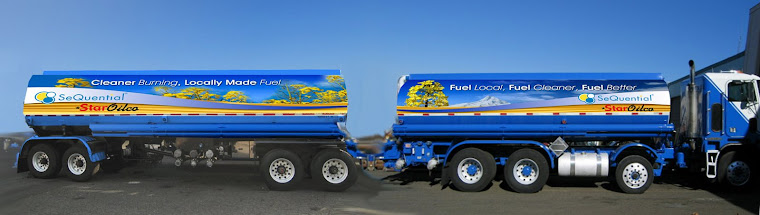
I saw a new press event for Propel Biofuels on the Biobased News site.
It seems like its been years since I've heard about Propel. I remember a few years ago they were poised to move forward boldly. Infused with V.C. cash and processing something more than that (a company chalked full of people filled with ability). They also had an awesome grasp of where to take the biofuel market to and therefore a compelling pitch to go with their business.
But after spending several hundred's of thousands of dollars building the best biodiesel infrastructure around Seattle their expectations didn't materialize. Of course nobody's expectations in the field did either. Now they are back pulling earned media and I like what I see.
Why do I like it? One self indulgent reason. Its the same argument and effort that I am making in Portland. I think they are correct except they are failing to see the real value in their business and intellectual property (which I will keep to myself). Its good to see your own logic and marketing packaging elsewhere.
Showing posts with label Biobased News. Show all posts
Showing posts with label Biobased News. Show all posts
Sunday, June 7, 2009


Thursday, April 23, 2009
Oregon Startup makes Biobased News
Diesel Brewing hits the biz wire.
I've never heard of this start up before but I'm intrigued. In particular butanol has a real promise to be used in biodiesel production as well as a gasoline blend stock. As it relates to biodiesel the butanol can be used as the alcohol in the transesterfication process.
Primarily methanol is the alcohol used. When butanol is used supposedly the gel point of the biodiesel drops significantly below 0 degrees.
Their formal website is http://www.dieselbrewing.com/
I neither endorse or am familiar with anyone associated with Diesel Brewing. I just saw the news and thought it interesting.
I've never heard of this start up before but I'm intrigued. In particular butanol has a real promise to be used in biodiesel production as well as a gasoline blend stock. As it relates to biodiesel the butanol can be used as the alcohol in the transesterfication process.
Primarily methanol is the alcohol used. When butanol is used supposedly the gel point of the biodiesel drops significantly below 0 degrees.
Their formal website is http://www.dieselbrewing.com/
I neither endorse or am familiar with anyone associated with Diesel Brewing. I just saw the news and thought it interesting.
Monday, July 21, 2008
Ethanol Industry Responds to OPEC

OPEC's members and official spokespersons have been claiming publicly for a few month now that ethanol was partially to blame for high crude oil prices. The ethanol industry has responded to these claims from the oil producing nations by taking out an advertisement explaining their perspective (ad shown above).
That perspective being simple. Ethanol increases and extends petroleum supplies and that existence in the market place puts a downward pressure on petroleum prices. Additionally (my words not theirs) its my impression that the Ethanol Producers are also implying that ethanol will soon be a real competitor for petroleum worldwide offering choice.
I saw the initial story at the Biobased News and followed it over to the RFA's Press Release.
The groups –- the Canadian Renewable Fuels Association (CRFA), the European Bioethanol Fuel Associations, the Brazilian Sugarcane and Ethanol Industry Association (UNICA) and the US Renewable Fuels Association – were answering the charges by OPEC that ethanol was in part responsible for the soaring price of crude oil, a price that will fetch OPEC nations more than $1.2 trillion dollars this year alone.
Also worth noting is the advertisement's citing of the Merrill Lynch study which claims that ethanol's effect on prices is downward. As without ethanol the world's petroleum producers would need to produce one million additional barrels of crude a day. The price effect of ethanol in the marketplace is believed to reduce overall crude prices as much as 15% according to the Merrill Lynch report.
Monday, May 12, 2008
Speculating on Oil Prices
There is an interesting story about the pricing expectations of a barrel of oil up on the Biobased news. Its a news wire piece on a recent KPMG poll of petroleum executives. The poll will be discussed at an upcoming KPMG Global Energy Institute conference.
Long story short. Over half of oil execs believe a barrel of oil will close below $100. See below:
In this year's KPMG survey, which polled 372 financial executives from oil and gas companies in April 2008, 55 percent of the respondents think that the price-per-barrel of crude oil will drop below $100 by the end of the year. Twenty-one percent think that the price will close between $101 and $110; 15 percent think between $111 and $120; and nine percent believe it will close at above $120. And, while 44 percent felt that prices would peak by the end of the year, a further 39 percent thought that they would not peak until after 2010.
Fair enough. Past as pretext for any speculation you would assume that the historical high would flatten out and trend lower. I would understand why that would be the majority consensus. What I don't follow is why 39% (not exactly a small contingent) thought oil wasn't going to peak until after 2010. I think this is evidence that there is some other factor effecting price currently and that this dynamic has yet to run its course.
Other interesting findings of the poll. The underlying cause for the increasing prices.
Indeed, a significant majority, or 63 percent, of oil and gas executives believe that growing demand due to accelerated demand in emerging markets is the major contributor to the high price of oil. The second highest contributor, according to 15 percent of the respondents, was the lack of access to new oil resources, and rising exploration and development costs. Ten percent attributed current pricing to growing demand in developed markets.
That supply was not readily available even with highs never before expected or seen. These same execs also mentioned a much bigger role for natural gas, see wind being a growth sector, and biofuels being a credible mass producible energy source within ten years.
Long story short. Over half of oil execs believe a barrel of oil will close below $100. See below:
In this year's KPMG survey, which polled 372 financial executives from oil and gas companies in April 2008, 55 percent of the respondents think that the price-per-barrel of crude oil will drop below $100 by the end of the year. Twenty-one percent think that the price will close between $101 and $110; 15 percent think between $111 and $120; and nine percent believe it will close at above $120. And, while 44 percent felt that prices would peak by the end of the year, a further 39 percent thought that they would not peak until after 2010.
Fair enough. Past as pretext for any speculation you would assume that the historical high would flatten out and trend lower. I would understand why that would be the majority consensus. What I don't follow is why 39% (not exactly a small contingent) thought oil wasn't going to peak until after 2010. I think this is evidence that there is some other factor effecting price currently and that this dynamic has yet to run its course.
Other interesting findings of the poll. The underlying cause for the increasing prices.
Indeed, a significant majority, or 63 percent, of oil and gas executives believe that growing demand due to accelerated demand in emerging markets is the major contributor to the high price of oil. The second highest contributor, according to 15 percent of the respondents, was the lack of access to new oil resources, and rising exploration and development costs. Ten percent attributed current pricing to growing demand in developed markets.
That supply was not readily available even with highs never before expected or seen. These same execs also mentioned a much bigger role for natural gas, see wind being a growth sector, and biofuels being a credible mass producible energy source within ten years.
Monday, April 28, 2008
How do you know the US Ethanol Tariff might be going away?
When major refiners starts investing in Ethanol South America.
I saw it over at the Biobased News where they cited a BP Press Release.
BP announced today that it intends to take a 50 per cent stake in Tropical BioEnergia SA, a joint venture established by Brazilian companies Santelisa Vale and Maeda Group, which is constructing a 435 million liter (115 million gallons) a year ethanol refinery in Edéia, Goias State, Brazil.
Quite the bet on BP's part. Or maybe that's the only way to play in Brazil. To build strategic partnerships with local biofuel producers. The Press Release points to sugar cane and sugar cane waste as the feedstocks. It also mentions the plants markets to be both domestic Brazil and export abroad.
NOTE: I have no basis for this speculation beyond my initial gut reaction when first reading the news. BP, Shell, Chevron, and Exxon Mobil have all been making good-sized biofuel bets as of late. Something about his one just seemed to run of the mill to be just another "bet on the future" PR move by major oil refiners.
I saw it over at the Biobased News where they cited a BP Press Release.
BP announced today that it intends to take a 50 per cent stake in Tropical BioEnergia SA, a joint venture established by Brazilian companies Santelisa Vale and Maeda Group, which is constructing a 435 million liter (115 million gallons) a year ethanol refinery in Edéia, Goias State, Brazil.
Quite the bet on BP's part. Or maybe that's the only way to play in Brazil. To build strategic partnerships with local biofuel producers. The Press Release points to sugar cane and sugar cane waste as the feedstocks. It also mentions the plants markets to be both domestic Brazil and export abroad.
NOTE: I have no basis for this speculation beyond my initial gut reaction when first reading the news. BP, Shell, Chevron, and Exxon Mobil have all been making good-sized biofuel bets as of late. Something about his one just seemed to run of the mill to be just another "bet on the future" PR move by major oil refiners.
Thursday, March 13, 2008
New Oilseed Crop - Cuphea

I saw the story first at Biobased News. This is the first I've heard of this oil seed type.
A good amount about Cuphea Oil is available on Wikipedia.
As described by the Biobased News this is a break through development. Being the only tropical oil crop type that will grow in North America. Or in the exact words of the Biobased News:
Part of the research focus at the USDA-Agricultural Research Service Lab in Morris is to develop new and alternative crops to diversify cropping systems in the northern Corn Belt region and offer new/improved economic and environmental benefits. Over the past seven years the Morris “Soils Lab” has been successful in developing a new oilseed crop called “cuphea” that has now become the only domestic crop-derived source of medium-chain fatty acid (MCFA) seed oil (i.e., seed oil similar to that of tropical plants) in the U.S. Until recently, the only plant-derived sources of MCFAs were coconut and palm oil.
The signifigance of this crop is that it produces medium-chain fatty acids (or MCFA's). This oil type being normally found in tropical oils which are relied on for soaps and other chemicals not to mention biodiesel.
Its always interesting to see new names pop up. Now I'm curious to see if this will be one of those blockbuster interest crops or a quiet but interesting additional crop.
Tuesday, February 19, 2008
Oregon Alfalfa Growers, Cellulosic Ethanol, and OSU in the News
From the Capital Press
Oregon: Alfalfa Growers Consider Biofuel Options
Feb 18, 2008 - By Patricia R. McCoy, Capital Press (I saw this first at the Biobased News)
RENO, Nev. - Biofuels have a place in filling U.S. energy needs, but they can't solve the entire problem.Cellulosic ethanol can be part of it, but the necessary technology development probably won't come as fast as is hoped, some 160 members of the Northwest Alfalfa Seed Growers Association heard here Jan. 21.There are currently no U.S. ethanol plants using cellulose as their seed stock, said Don Wysocki, Oregon State University extension soil scientist stationed at Pendleton, Ore. The first one is likely five to 10 years away from construction.
Just to mention it. Cellulosic ethanol is here now. The issue is that it's not considered cost competive unless corn and petroleum prices stay at their now record levels. So it all hinges not on the technology but the commodity prices of petroleum and corn.
There are several real players pursuing cellulosic ethanol right now in Oregon. The most prominent being Pacific Ethanol which will be running a demonstration of cellulosic ethanol at it's Port of Morrow, Oregon plant this summer. Also worth mentioning is Trillium Fiber Fuels out of Corvallis, Oregon which promises the ability to build a commercial scale plant given the right market conditions (they've demonstrated now that they need the right conditions to own their technology while going commericial scale).
Also worth mentioning is the fact that the paper industry and cellulosic ethanol have many of the same technologies in common. The technology to strip the lignen from the cellulosic fiber is used currently by the paper industry. In fact they manufacture methanol in biodigesters and burn it as a cheap energy product called black liquor. Cellulosic ethanol just requires more efficient yields than current paper pulping which isn't making ethanol but instead the cellulosic fiber itself.
We have industrial infrastructure to handle the technical process, experienced engineers, the distributors of enzymes and bugs, not to mention a world class amount of woody material and agricultural producers to contribute to this industry. Oh yeah - did I mention the highest retail gasoline prices in the US combined with a 10% ethanol mandate year round. Oregon is prime for cellulose sooner rather than later. I would say 10 years only if oil drops back below $60 a barrel.
Oregon: Alfalfa Growers Consider Biofuel Options
Feb 18, 2008 - By Patricia R. McCoy, Capital Press (I saw this first at the Biobased News)
RENO, Nev. - Biofuels have a place in filling U.S. energy needs, but they can't solve the entire problem.Cellulosic ethanol can be part of it, but the necessary technology development probably won't come as fast as is hoped, some 160 members of the Northwest Alfalfa Seed Growers Association heard here Jan. 21.There are currently no U.S. ethanol plants using cellulose as their seed stock, said Don Wysocki, Oregon State University extension soil scientist stationed at Pendleton, Ore. The first one is likely five to 10 years away from construction.
Just to mention it. Cellulosic ethanol is here now. The issue is that it's not considered cost competive unless corn and petroleum prices stay at their now record levels. So it all hinges not on the technology but the commodity prices of petroleum and corn.
There are several real players pursuing cellulosic ethanol right now in Oregon. The most prominent being Pacific Ethanol which will be running a demonstration of cellulosic ethanol at it's Port of Morrow, Oregon plant this summer. Also worth mentioning is Trillium Fiber Fuels out of Corvallis, Oregon which promises the ability to build a commercial scale plant given the right market conditions (they've demonstrated now that they need the right conditions to own their technology while going commericial scale).
Also worth mentioning is the fact that the paper industry and cellulosic ethanol have many of the same technologies in common. The technology to strip the lignen from the cellulosic fiber is used currently by the paper industry. In fact they manufacture methanol in biodigesters and burn it as a cheap energy product called black liquor. Cellulosic ethanol just requires more efficient yields than current paper pulping which isn't making ethanol but instead the cellulosic fiber itself.
We have industrial infrastructure to handle the technical process, experienced engineers, the distributors of enzymes and bugs, not to mention a world class amount of woody material and agricultural producers to contribute to this industry. Oh yeah - did I mention the highest retail gasoline prices in the US combined with a 10% ethanol mandate year round. Oregon is prime for cellulose sooner rather than later. I would say 10 years only if oil drops back below $60 a barrel.
Friday, December 28, 2007
Soy Bean Board looks "Beyond Bean"
Some interesting proposals of what will next be viably made out of soy beans.
- Soy plastics and foam use by auto makers.
- Soy based foam for home insulation.
- Soy foam backed carpeting in your house and commercial building.
- And the ultimate sole purpose for this post: Perry Ellis Soy-Underwear, with soy based textile fibers.
From the Biobased News.
- Soy plastics and foam use by auto makers.
- Soy based foam for home insulation.
- Soy foam backed carpeting in your house and commercial building.
- And the ultimate sole purpose for this post: Perry Ellis Soy-Underwear, with soy based textile fibers.
From the Biobased News.
Thursday, December 13, 2007
Willow - Potential Biofuel Feedstock

Joel Ens, a grad student from the University of Saskatchewan, has proposed willow as a potential biofuel and biomass feedstock. The willow offers characteristics of growing long consistent branches rapidly. The full article available by stopping by the Biobased News.
I've never heard of a pruning a fast growing tree. Looking this direction might have real potential for Oregon. Oregon being a highly productive nursery tree state, the Willamette Valley having a great deal of rain fall, and the idea of landscaping trees serving a dual purpose should be promising.
I have heard similar proposals around bamboo as a great perennial crop. The big difference with willow being a twenty year scope of rotation versus a few years for bamboo. The bamboo root ball become to dense after a few years but bamboo as a crop should allow multiple harvests a year. The great consistent rain fall of the Willamette Valley in Oregon also contributing a great deal to the productive potential for a bamboo biomass crop.
Monday, November 26, 2007
The Bioprocessing Revolution
Mark Zappi has an op-ed piece that popped up on the Biobased News site. Zappi is the dean of Engineering and Director of the Bioprocessing Research Laboratory at the University of Louisiana.
A Peek into the New Industrial Revolution - Bioprocessing
Its worth reading. Spot on explanation in what I see happening as well.
An excerpt below:
The industrial revolution of the 1800’s and 1900’s was based on steel, fossil fuels, bricks, and mortar. Now these are staples in America’s industrial toolbox. However, most experts agree that the next industrial revolution that is just beginning is one that will be based on biology-based materials or biomass.
This revolution will usher in a totally new paradigm in terms of how society views both farm products and our organically rich wastes. Agriculture will diversify from producing only foodstocks to producing both crops for food and crops for chemical production, or in other words, both foodstocks and chemical crops. Chemical companies are investing tremendous monetary and intellectual capital in biotechnology that focuses on harnessing the vast chemical potential of plants. The result will surely be new relationships blossoming between the agricultural and chemicals production industries.
And then Zappi waves a big Louisiana flag around this emerging industry bringing this technological shift's significance home:
And Louisiana? I believe that our great state will continue its leadership role as a source of chemicals and fuel. Louisiana is one of the leading states when considering its capability to produce tremendous tonnage each year of biomass. Given the vast chemical production and supporting transportation infrastructure in place coupled with its highly productive agricultural capability, Louisiana should emerge as a leader in bioprocessing.
This is the first time I've come across Zappi. So far I like what I see and it's definitely worth a Google. I especially love those advocates for bioproducts who bring the new technology into context. Mark Zappi does a great job of doing that in this piece.
A Peek into the New Industrial Revolution - Bioprocessing
Its worth reading. Spot on explanation in what I see happening as well.
An excerpt below:
The industrial revolution of the 1800’s and 1900’s was based on steel, fossil fuels, bricks, and mortar. Now these are staples in America’s industrial toolbox. However, most experts agree that the next industrial revolution that is just beginning is one that will be based on biology-based materials or biomass.
This revolution will usher in a totally new paradigm in terms of how society views both farm products and our organically rich wastes. Agriculture will diversify from producing only foodstocks to producing both crops for food and crops for chemical production, or in other words, both foodstocks and chemical crops. Chemical companies are investing tremendous monetary and intellectual capital in biotechnology that focuses on harnessing the vast chemical potential of plants. The result will surely be new relationships blossoming between the agricultural and chemicals production industries.
And then Zappi waves a big Louisiana flag around this emerging industry bringing this technological shift's significance home:
And Louisiana? I believe that our great state will continue its leadership role as a source of chemicals and fuel. Louisiana is one of the leading states when considering its capability to produce tremendous tonnage each year of biomass. Given the vast chemical production and supporting transportation infrastructure in place coupled with its highly productive agricultural capability, Louisiana should emerge as a leader in bioprocessing.
This is the first time I've come across Zappi. So far I like what I see and it's definitely worth a Google. I especially love those advocates for bioproducts who bring the new technology into context. Mark Zappi does a great job of doing that in this piece.
Friday, November 16, 2007
Europe and Biodegradable Lubes
Lubes and Greases North America covers the emerging European standard for biodegradable and biobased lubes. If you are curious about why biobased lubes aren't tearing up the marketplace like biofuels are the standardization issues of Europe lay some of it out for you. (See page 38 for the start of the article)
As many in the US consider biobased lubes as a potential growth opportunity for the biofuel industry these off the beaten path trade information sources become more an more valuable. Usually the only sources of information about these emerging technologies are found from those making the products and of course the claims about them.
From my understanding biobased lubes stand the best market development placement as one of two things. Hydraulic fluids or heat transfer oils. Lubricating oils require some pretty noxious chemicals and heavy metals to make them function as lubricants in especially in extreme environments (such as a windmill gear box).
So in essence you would be creating hazardous waste (even though the base stock would by biobased) and you would be substantially increasing the service requirements of the equipment. Take for instance gear box applications. With full synthetic petroleum based lubes you have extremely long drain intervals. Especially for remote equipment that is expensive and energy intensive to service. The inconsistency of on road vehicle engines also make the passenger car market also a poor place for biobased lubes.
The easy to reach markets for biobased lubes is in near water applications. Interestingly enough most industrial operations near rivers and water are hydraulic in nature. Moving containers off of ships being the most prominent industrial activity. Biobased lubes being a superior hydraulic fluid in this case.
When looking at biobased lubes look at the application not the market. Common sense goes along way in examining the higher value products of the petroleum world and where biobased substitutes can easily cross over.
Special Note: Please do not confuse biobased lubes with biodegradable lubes. There is a difference. There are petroleum based synthetics that are readily biodegradable on a comparable level with biobased products. These have a much longer track record with performance levels similar to non-biodegradable counterparts. These biodegradable products also have a long track record of comparable performance along no biodegradable lubes.
As many in the US consider biobased lubes as a potential growth opportunity for the biofuel industry these off the beaten path trade information sources become more an more valuable. Usually the only sources of information about these emerging technologies are found from those making the products and of course the claims about them.
From my understanding biobased lubes stand the best market development placement as one of two things. Hydraulic fluids or heat transfer oils. Lubricating oils require some pretty noxious chemicals and heavy metals to make them function as lubricants in especially in extreme environments (such as a windmill gear box).
So in essence you would be creating hazardous waste (even though the base stock would by biobased) and you would be substantially increasing the service requirements of the equipment. Take for instance gear box applications. With full synthetic petroleum based lubes you have extremely long drain intervals. Especially for remote equipment that is expensive and energy intensive to service. The inconsistency of on road vehicle engines also make the passenger car market also a poor place for biobased lubes.
The easy to reach markets for biobased lubes is in near water applications. Interestingly enough most industrial operations near rivers and water are hydraulic in nature. Moving containers off of ships being the most prominent industrial activity. Biobased lubes being a superior hydraulic fluid in this case.
When looking at biobased lubes look at the application not the market. Common sense goes along way in examining the higher value products of the petroleum world and where biobased substitutes can easily cross over.
Special Note: Please do not confuse biobased lubes with biodegradable lubes. There is a difference. There are petroleum based synthetics that are readily biodegradable on a comparable level with biobased products. These have a much longer track record with performance levels similar to non-biodegradable counterparts. These biodegradable products also have a long track record of comparable performance along no biodegradable lubes.
Tuesday, November 13, 2007
Green Star and the "Food vs. Fuel" Debate.
I saw this press release in the Biobased News.
Recently a UN report blasted the effect biofuels would have on food (commonly referred to as the "Food vs. Fuel debate"). From what I understand the biggest criticism being hoisted towards ethanol production's push on recent corn prices. In rebuttal, Green Star Products issues a press release citing soy as an example of a Food and Fuel opportunity.
In short = Green Star blasts ethanol from corn, points to soy as a good feedstock to be developed in farming rotations, and that algae has a huge potential future to make all these issues moot (note that Green Star also has high hopes for algae).
The coolest fact in the press release:
For each bushel (60 pounds) of soybeans produced only 10 pounds of extracted oil is used in making biodiesel. The other 50 pounds (the soy meal) is used to feed the hungry of the world as one of the best high protein foods available.
Recently a UN report blasted the effect biofuels would have on food (commonly referred to as the "Food vs. Fuel debate"). From what I understand the biggest criticism being hoisted towards ethanol production's push on recent corn prices. In rebuttal, Green Star Products issues a press release citing soy as an example of a Food and Fuel opportunity.
In short = Green Star blasts ethanol from corn, points to soy as a good feedstock to be developed in farming rotations, and that algae has a huge potential future to make all these issues moot (note that Green Star also has high hopes for algae).
The coolest fact in the press release:
For each bushel (60 pounds) of soybeans produced only 10 pounds of extracted oil is used in making biodiesel. The other 50 pounds (the soy meal) is used to feed the hungry of the world as one of the best high protein foods available.
Wednesday, October 17, 2007
PetroSun Issues Algae-to-Biofuels Update
Read the Press Release at the Biobased News.
The important info from the Press Release:
PetroSun plans to produce 180,000,000 of algal oil (that's right that many zeros).
This production number is for the year starting 2009.
The algae production plants are expected to be completed in 2008 in the proposed states of Alabama, Louisiana and Arizona.
PetroSun plans to sell this crude oil tracking the price of petroleum crude.
PetroSun is notable because the company has a background in Oil and Gas development and made the cross-over move to biofuels production in recent years.
My thoughts on algae:
Its way easier said than done.
Its way easier done than done right for that matter.
The issue being genetic pollution. Algae is nearly impossible to get as a consistent strain. Therefore from what I understand algae's real promise is as a scrubber or grey water cleaner.
My money is on algae technologies that do something (scrub emissions, pollutants, clean industrial grey water, etc....). Algae will be paired with biofuels only as a non-foodgrade biofuel feedstock as a waste stream offtake partner.
The important info from the Press Release:
PetroSun plans to produce 180,000,000 of algal oil (that's right that many zeros).
This production number is for the year starting 2009.
The algae production plants are expected to be completed in 2008 in the proposed states of Alabama, Louisiana and Arizona.
PetroSun plans to sell this crude oil tracking the price of petroleum crude.
PetroSun is notable because the company has a background in Oil and Gas development and made the cross-over move to biofuels production in recent years.
My thoughts on algae:
Its way easier said than done.
Its way easier done than done right for that matter.
The issue being genetic pollution. Algae is nearly impossible to get as a consistent strain. Therefore from what I understand algae's real promise is as a scrubber or grey water cleaner.
My money is on algae technologies that do something (scrub emissions, pollutants, clean industrial grey water, etc....). Algae will be paired with biofuels only as a non-foodgrade biofuel feedstock as a waste stream offtake partner.
Tuesday, October 16, 2007
Well Said...
I guess I'm what you'd call a fan of the BiobasedNews.
Why? Well an editorial that popped up today sums up my feelings very well. This seems to happen often with their news service (they are great content filters). Its great to feel like your in good company.
Peter Nelson, BioDimensions in an editorial called "The Big Question Mark":
A few years ago I saw a chart from Royal Dutch Shell that showed projected sources of energy production over the next hundred years. The chart showed a rising percentage in the use of solar, wind, biomass as well as coal, nuclear and/other more traditional sources. However the most interesting element was the top twenty to thirty percent had a big question mark.
The question mark represented the quantity of energy that would be produced over the coming decades from technologies and innovations that have yet to be discovered. I loved this chart because it captured the idea that we so often forget – that the emerging green/renewable revolution is only in its infancy and that there will be amazing and unknown opportunities for biobased products as other markets
grow.
As I have written before, so many of the arguments involving ethanol or other ideas are in so many ways the same as early arguments about the viability of computers when they were still the size of a small house. As efficiencies and new technologies were discovered, the possibilities broadened. For instance, I am constantly pointing out the need to capture the highest value for each plant component, as well as the need to dramatically expand the types of feedstocks available, each with their own unique characteristics.
Its worth the read.
In particular he captures the opportunity in the value added products far beyond just commodity biofuels. Remember, that's where all refining must go to stay competitive in a mature market.
Either a refining operation must own below market feedstocks or above market profit niches to sell into. Otherwise price inversions will do away with a refinery operating at the barest margin. Look to the value added technologies or business models that broaden the possibility of the industry. Those players will be the paradigm shifters.
Why? Well an editorial that popped up today sums up my feelings very well. This seems to happen often with their news service (they are great content filters). Its great to feel like your in good company.
Peter Nelson, BioDimensions in an editorial called "The Big Question Mark":
A few years ago I saw a chart from Royal Dutch Shell that showed projected sources of energy production over the next hundred years. The chart showed a rising percentage in the use of solar, wind, biomass as well as coal, nuclear and/other more traditional sources. However the most interesting element was the top twenty to thirty percent had a big question mark.
The question mark represented the quantity of energy that would be produced over the coming decades from technologies and innovations that have yet to be discovered. I loved this chart because it captured the idea that we so often forget – that the emerging green/renewable revolution is only in its infancy and that there will be amazing and unknown opportunities for biobased products as other markets
grow.
As I have written before, so many of the arguments involving ethanol or other ideas are in so many ways the same as early arguments about the viability of computers when they were still the size of a small house. As efficiencies and new technologies were discovered, the possibilities broadened. For instance, I am constantly pointing out the need to capture the highest value for each plant component, as well as the need to dramatically expand the types of feedstocks available, each with their own unique characteristics.
Its worth the read.
In particular he captures the opportunity in the value added products far beyond just commodity biofuels. Remember, that's where all refining must go to stay competitive in a mature market.
Either a refining operation must own below market feedstocks or above market profit niches to sell into. Otherwise price inversions will do away with a refinery operating at the barest margin. Look to the value added technologies or business models that broaden the possibility of the industry. Those players will be the paradigm shifters.
Dot-Com Comparison
Biobased News has a great editorial comparing the Dot-Com era to the current biofuels boom. An excerpt below:
The dot-com bubble was marked by unrealistic speculation involving faulty business models. The resulting business plans overestimated projections, included wild claims about market share, often did not consider factors such as logistics, and were backed by an impressive list of bios for personnel who passionately believed in the potential for the new companies but many times lacked legitimate experience.
In hindsight it has been apparent that basic business development questions should have been asked such as, “How long has the management team worked together?” Unfortunately these and other crucial questions were often ignored in the wave of excitement. Sound familiar to what is going on now?
My thoughts:
You've probably heard the comparison of the emerging biofuels sector to the dot-com era of the late nineties before. This is not a very original thought and you hear it more and more these days. There are a great many comparisons between the investing era we are in today and the bubble of the late 90's.
There are also some very large difference. In particular biofuels takes a great deal of physical capital at even the outset.
Biofuels being a physical product the actual innovation requires more than just a good idea taken to market. Biofuels creates a few ASTM products with strict quality assurance requirements. These biofuel products must also integrate into a preexisting petroleum sector (which often doesn't willing play nice with the new kids on the block). Combine this with measurable quantities and a market price which combine together to create real cashflow expectations and you've got a much more manageable business than a e-Commerce concept.
In essence the big difference is that with a biofuels business you can call B.S. much earlier than an e-Commerce business. This is further compounded with the fact that biofuel companies require credible real relationships with not only customers but distributors who must make clear decisions of which biofuels companies they will work with. This increasing the opportunities for a less than credible entrant to be handed the moniker "bull-shit" (this being an industry standard petroleum term).
In essence, even with smoke and mirrors, biofuels requires measurable results and distribution relationships. These can be measured at a great distance with little prior industry experience as an investor.
This separates the two sectors greatly. It still doesn't stop the Dot-Com refugees and I.T. tourists from cruising through our conferences though looking for that "killer ap" equivalent in a biofuel technology. Not that I would want the to stop, they make talking about the subject fun just on an enthusiasm level alone.
The dot-com bubble was marked by unrealistic speculation involving faulty business models. The resulting business plans overestimated projections, included wild claims about market share, often did not consider factors such as logistics, and were backed by an impressive list of bios for personnel who passionately believed in the potential for the new companies but many times lacked legitimate experience.
In hindsight it has been apparent that basic business development questions should have been asked such as, “How long has the management team worked together?” Unfortunately these and other crucial questions were often ignored in the wave of excitement. Sound familiar to what is going on now?
My thoughts:
You've probably heard the comparison of the emerging biofuels sector to the dot-com era of the late nineties before. This is not a very original thought and you hear it more and more these days. There are a great many comparisons between the investing era we are in today and the bubble of the late 90's.
There are also some very large difference. In particular biofuels takes a great deal of physical capital at even the outset.
Biofuels being a physical product the actual innovation requires more than just a good idea taken to market. Biofuels creates a few ASTM products with strict quality assurance requirements. These biofuel products must also integrate into a preexisting petroleum sector (which often doesn't willing play nice with the new kids on the block). Combine this with measurable quantities and a market price which combine together to create real cashflow expectations and you've got a much more manageable business than a e-Commerce concept.
In essence the big difference is that with a biofuels business you can call B.S. much earlier than an e-Commerce business. This is further compounded with the fact that biofuel companies require credible real relationships with not only customers but distributors who must make clear decisions of which biofuels companies they will work with. This increasing the opportunities for a less than credible entrant to be handed the moniker "bull-shit" (this being an industry standard petroleum term).
In essence, even with smoke and mirrors, biofuels requires measurable results and distribution relationships. These can be measured at a great distance with little prior industry experience as an investor.
This separates the two sectors greatly. It still doesn't stop the Dot-Com refugees and I.T. tourists from cruising through our conferences though looking for that "killer ap" equivalent in a biofuel technology. Not that I would want the to stop, they make talking about the subject fun just on an enthusiasm level alone.
Subscribe to:
Posts (Atom)