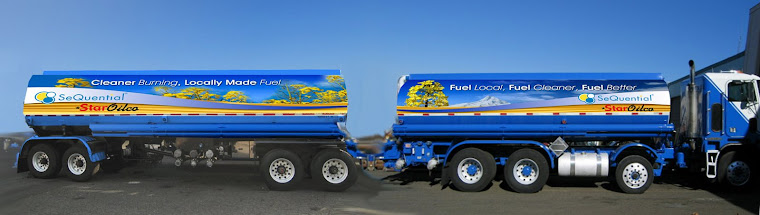
Today I got a call from Energy Today Magazine about our business. In checking into their online addition I came across a few good articles. One in particular goes in depth to the process of capturing and developing oil sands in Alberta, Canada.
An excerpt from Cooperation Needed by Brent Sangster:
The mining and extraction process made a dramatic technological leap in the 1980s when it converted from dragline and bucket wheels to hydraulic and electric shovels that load the raw material (e.g., sand, clay, bitumen) on to massive trucks that today have a capacity of 400 tons.
These trucks transport the material to a crusher, where it is slurried with water before being transported via pipeline to an extraction plant. New technology is being tested here to move the crushing and slurrying operations right to the mine face, eliminating trucks or at least significantly reducing hauling distances.At the extraction plant, the bitumen is isolated from the water, sand, and clay (known as tailings), which are pumped into large containment ponds for settling and eventual reuse. Some unrecovered bitumen and naptha finds its way into these ponds as well.
Tailings ponds are designed to reclaim both the water and the area itself as a natural habitat. But the silts in the mixture can take many years to settle, during which time nearby water sources must be safeguarded from contamination and the ponds must be monitored to ensure wildlife is not exposed.
Technological issues here focus on ways to increase the speed of silt settling, such as using chemical thickeners or centrifuges to separate the silt from the water. Other needed advancements include technologies to remove the residual bitumen, recover valuable minerals such as zircon, and polish the water for re-use.
Just something I thought might be worth finding again.
Showing posts with label Petroleum. Show all posts
Showing posts with label Petroleum. Show all posts
Thursday, February 25, 2010


Friday, August 28, 2009
150 Years of Progress.... Now Time for the Next Paradigm
Yesterday marked the 150 birthday of the commercial petroleum industry. With Edwin Drake's discovery of oil in Pennsylvania the future of western civilization was moved forward at a speed unpredictable and mind bending. Ironically (a little trivia history) the day Drake struck oil was the day he received word from his backers to pull out and stop drilling.
Wired Magazine and Fastcompany both have tribute mentions on their website.
Usually presented as a force for evil or sinister change the benefits of petroleum have been spectacular. The immediate ability of humanity to harvest the btu's and calories of another geological dynasty has been good to those of us in the U.S.. Bending hydrogen and carbon molecules to our own needs has given us wealth and lifestyles beyond the imagination of any human alive in the 19th century. At the time of the American revolution in fact the wealth and lifestyle of today's American middle class would impress the great monarchs of Europe. From food and entertainment options the wealth cheap power provides is mind boggling when you consider it.
That brings us to what next? I would like to state simply (in honor of the 150th anniversery of petroleum) a hypothesis. That the prominence of petroleum at the center of our civilization is because of two items. One the cost of extraction is so cheap that the product is nearly free in comparison to most other products. Two, the amount of research and development reinvested by the petroleum industry have turned this nearly free btu rich product into the center piece it is to our civilization.
In short, as petroleum costs rise there is no reason other products will not take petroleum's place. In fact the harvesting of biomass and recapture of garbage can provide 100% of our energy in a closed carbon neutral loop. It only takes two things. A little market share for these new synthetic crude technologies as well as 150 years of experiments to bring them along to where petroleum is.
Look them up. Fast pyrolisis, Fischer-Tropsch, thermal depolymerization, and similar variant technologies. All simulating the Earth's geological process that created crude oil by heat, pressure and a oxygen poor environment. Reforming biological materials commonly seen around us magically into a source product for everything we take for granted in the modern world.
Wired Magazine and Fastcompany both have tribute mentions on their website.
Usually presented as a force for evil or sinister change the benefits of petroleum have been spectacular. The immediate ability of humanity to harvest the btu's and calories of another geological dynasty has been good to those of us in the U.S.. Bending hydrogen and carbon molecules to our own needs has given us wealth and lifestyles beyond the imagination of any human alive in the 19th century. At the time of the American revolution in fact the wealth and lifestyle of today's American middle class would impress the great monarchs of Europe. From food and entertainment options the wealth cheap power provides is mind boggling when you consider it.
That brings us to what next? I would like to state simply (in honor of the 150th anniversery of petroleum) a hypothesis. That the prominence of petroleum at the center of our civilization is because of two items. One the cost of extraction is so cheap that the product is nearly free in comparison to most other products. Two, the amount of research and development reinvested by the petroleum industry have turned this nearly free btu rich product into the center piece it is to our civilization.
In short, as petroleum costs rise there is no reason other products will not take petroleum's place. In fact the harvesting of biomass and recapture of garbage can provide 100% of our energy in a closed carbon neutral loop. It only takes two things. A little market share for these new synthetic crude technologies as well as 150 years of experiments to bring them along to where petroleum is.
Look them up. Fast pyrolisis, Fischer-Tropsch, thermal depolymerization, and similar variant technologies. All simulating the Earth's geological process that created crude oil by heat, pressure and a oxygen poor environment. Reforming biological materials commonly seen around us magically into a source product for everything we take for granted in the modern world.
Sunday, April 12, 2009
OPEC wants cheap oil.... Hmmmm?
Saw the analysis at MSNBC online from a month ago. Not exactly timely but something jumped out at me that will alter my perception of what the future might hold.
OPEC tried on Sunday to nudge oil prices up by urging its members to stop overproducing, but the cartel decided not to cut current output levels which could have driven prices sharply higher. Explaining the decision, OPEC Secretary-General Abdalla el-Badri spoke of his organization's concern over "ugly" global economic times that overrode the desire to achieve a quick fix by setting a lower overall output for the 12-nation producer's club.
First off, I'm thoroughly entertained that a roughly $50 a barrel and $2+ gasoline is considered "Cheap" by today's standards. Two years ago it was not.
I know. Everyone got used to a $200 barrel of crude being a realistic price. Regardless, I remember making biodiesel and ethanol pitches back when diesel was expensive at $0.75/a gallon and being told that no one would ever buy a biofuel unless it was cheaper. And oil would never trade wholesale above $1 a gallon.
I remember one time on-road diesel with taxes hit $1.28 and customers called to complain wanting to know "HOW" it was possible that prices could swing so high (it was caused by a sudden shutting down of the Olympic Pipeline into Portland by regulators because of safety issues).
My how we've changed our definitions and expectations. Me included (I get really nostalgic at times for a high price of oil being $15 a barrel back when I started at StarOilco).
Oh how life was easier in the oil business when I was empowered with an Economics degree and so much certainty. But enough of the simple past - the future has much more potential and a greater opportunity with those with open minds and strong backs.
Also add to this that OPEC likely has not forgotten that this is not "cheap" but a dream-boat of oil pricing and acceptability. If the harshest international recession of the last 80 years leaves the bottom of the market at $50 barrel of crude they will be very happy with this new economic picture for oil.
This is the real point of my post. Calibrate your instruments. $50 is the new floor for the foreseeable future. If the price of a barrel of oil starts trading below this number there is a change in the economic numbers that set prices.
If I was a practicing economist I would try to set up an experiment to determine volumes of ethanol, biodiesel, renewable diesel, syn diesel, and other fuel volumes as they effect over all pricing of petroleum. It would be fun to try and create an easy factor of volumes of substitutes (even if they trade at a surplus cost) and their effect on petroleum prices.
Given the US's energy position in the world not only as a consumer but market that sets prices you would likely be able to just use EPA and DOE numbers to run such an experiment. I would treat the measurements much like the Federal Reserve tracks the money supply. With an E1 for only petroleum refined products sold, E2 including immediate blendable substitutes including mandated blends, and an E3 and E4 for moving to wider industrial substitutes such as hog fuel, and experimental fuels manufactured outside of the main streams of commerce.
There has been very little talk about this (other than by the ethanol industry). To me this is the future of the debate. If only I could simultaneously work and be an academic. Ahh, the dream. Being able to actual focus on the bigger picture without the requirement of betting correctly with your own money.
Sunday, March 1, 2009
Natural Gas vs. Diesel
It's happended for the first time in a while. Diesel is competitive with natural gas.
Wholesale diesel is under $1.20 a gallon which places it below retail natural gas at over $1 a therm (or $10 per million Btu). If you buy gas look at your utility bill. Its significantly cheaper to go oil for the first time in four or five year.
I don't pay attention to Nymex Natural gas costs but I understand those are way down. That's good sign for commercial users buying their own gas and paying the utility for delivery. Regardless for a heating oil distributor like myself this might be a ray of sunshine in a recession as the smaller dual fuel boilers and heating oil customers see value in staying oil.
Wholesale diesel is under $1.20 a gallon which places it below retail natural gas at over $1 a therm (or $10 per million Btu). If you buy gas look at your utility bill. Its significantly cheaper to go oil for the first time in four or five year.
I don't pay attention to Nymex Natural gas costs but I understand those are way down. That's good sign for commercial users buying their own gas and paying the utility for delivery. Regardless for a heating oil distributor like myself this might be a ray of sunshine in a recession as the smaller dual fuel boilers and heating oil customers see value in staying oil.
Heating Oil at $1.20 a gallon is cheaper than natural gas.
$1.20/ 131,000 btus = .000009160305344 per btu
.000009160305344 x 100,000 btu's per therm of Natural Gas = $ .916 per therm equivalent
Sunday, January 4, 2009
My Opinion of New Gas Taxes for the Sake of New Taxes
 Wired Magazine (as well as many others) are advocating for a motor fuel tax increase. Or in Wired's words:
We've already shown we can live with gas at $4 a gallon (less than half what some European countries saw during the price spikes last summer) without inviting the apocalypse. That pretty much shoots down the argument that people won't stand for higher gas prices. And, as Time magazine notes, an increase in the gas tax could be offset by a cut in the payroll tax, which has a far greater impact on our pocketbooks, anyway.
This argument (because we can afford it) is a horrible way to build a consensus around energy. Often referred to as an Apollo Project like grand marshaling of effort. That is what the US and world need now. A grand wide-ranging effort.
This argument though is unconvincing to me. In fact its the height of ivory tower belligerence in my opinion. As someone who has taken the bad debts of bankrupt businesses recently unable to cover the cash flow needs of high prices I differ about how "we can live with gas at $4" compared to those disengaged with the actual customers of this product. Its hard to justify a tax simply to improve the policy goals of our government in conflict with the actual cost of operating effect of small business and the low rungs of our economy.
Seeing the impact of $4 a gallon heating oil to my elderly customers it is painful. It hurts emotionally and stuns me reconciling my own belief in the free-market with a desperate want of an affordable option for these customers impacted. When you need to talk to trucking companies and other industrial diesel users with decades of good credit history now struggling to pay for the fuel cost of operating requires a tough choice on my end is also equally as hard.
High energy prices is dangerous and hard. It is not something we can live with. Especially if its just to tax and then spend. We need an actual policy. One that doesn't solely raise prices but allocates the incentive for a diverse, domestic, and sustainable portfolio of energy.
Our energy shouldn't be that high prices are okay. Our policy should be as inexpensive as possible with an ever improving requirement for reducing impact. I have no doubt that we can have extreme-low-impact energy at a cost far below $4 a gallon. All it takes is more competition and improved technology.
To move our energy infrastructure forward is not the job of a gas tax. A Btu tax maybe. A CO2 tax probably. Those would allow the market to support long range innovation and more importantly a wider/smarter grid to allow for more players. These would work if the money was directly placed in off-setting the Federal tax deductions for utility and refiners investing in new capital and infrastructure. Regardless of what tax though it needs to be evenly distributed on those sources of energy that come from outside North America and bolster an incentive for new locally produced energy.
A gas tax to rebuild infrastructure for gasoline users. That I agree with if it is connected (users of roads paying for improved roads is good policy). The real catch is that legislators (be they Federal or State) don't connect a $1 or revenue with a $1 of infrastructure. Even when mandated usually the added revenue gets sucked up by the Administration of departments long before it sees the laying of asphalt or raising of bridges.
Don't fall for those knee-jerk taxation lovers looking for an angle for any more revenue to dole out. Ready, shoot, aim with the US tax code will not move us forward. Likely only backward. Without a clear results oriented policy taxes rarely accomplish anything but more special interest involvement restricting further progress.
Thursday, December 11, 2008
Oil Execs on the Future of Energy Costs
Reported at the Environmental Leader
See the graphic below. The study was based on in-depth phone interviews with more than 50 oil and gas professionals, most holding C-Suite positions at petroleum companies with annual revenues of $100 million or more.

Of note to me. The low number of petroleum executives that believe petroleum is a sustainable energy source. I would really like to know what the motivation for this answer would be. The environmental sense of "sustainable" in reference to CO2 and impact on the environment or the actual long term production (meaning that they can sustainable keep pumping oil out of the ground keeping up with the actual demand for the product).
Usually when oil and gas people talk about sustainability they talk about actual production. Sustainable production is keeping up with demand. So they usually refer to petroleum as a sustainable fuel. Contrast this with environmentalists who refer to "sustainable" as meaning little or no impact on the environment.
I also see this as an interesting contrast with the feelings about US energy independence. If Oil is not sustainable what would be there belief for energy independence? I would assume biofuels development or maybe just something else (those in energy tend to look at technology as an open ended box of hope).
Are these execs saying 'it'll all work out some how' or do they have a consensus inside the industry about an expected future for US energy.
See the graphic below. The study was based on in-depth phone interviews with more than 50 oil and gas professionals, most holding C-Suite positions at petroleum companies with annual revenues of $100 million or more.

Of note to me. The low number of petroleum executives that believe petroleum is a sustainable energy source. I would really like to know what the motivation for this answer would be. The environmental sense of "sustainable" in reference to CO2 and impact on the environment or the actual long term production (meaning that they can sustainable keep pumping oil out of the ground keeping up with the actual demand for the product).
Usually when oil and gas people talk about sustainability they talk about actual production. Sustainable production is keeping up with demand. So they usually refer to petroleum as a sustainable fuel. Contrast this with environmentalists who refer to "sustainable" as meaning little or no impact on the environment.
I also see this as an interesting contrast with the feelings about US energy independence. If Oil is not sustainable what would be there belief for energy independence? I would assume biofuels development or maybe just something else (those in energy tend to look at technology as an open ended box of hope).
Are these execs saying 'it'll all work out some how' or do they have a consensus inside the industry about an expected future for US energy.
Monday, October 27, 2008
The Pickens Plan on 60 Minutes
"We are at war with no guns with energy."
- T. Boones Pickens
Share/Embed
I saw the 60 Minute piece online. It is interesting and bold. The big new idea I'm hearing is a Federal push to build an energy infrastructure much like the major Freeway projects of the 50's. A modern new backbone for wind and solar power to plug these resources into.
By pushing for wind power and new grid infrastructure to plug into this would free up the necessary natural gas for on-road vehicles and freight mobility. I'm hopeful and like the conversation this is spurring.
- T. Boones Pickens
Share/Embed
I saw the 60 Minute piece online. It is interesting and bold. The big new idea I'm hearing is a Federal push to build an energy infrastructure much like the major Freeway projects of the 50's. A modern new backbone for wind and solar power to plug these resources into.
By pushing for wind power and new grid infrastructure to plug into this would free up the necessary natural gas for on-road vehicles and freight mobility. I'm hopeful and like the conversation this is spurring.
Monday, July 21, 2008
Ethanol Industry Responds to OPEC

OPEC's members and official spokespersons have been claiming publicly for a few month now that ethanol was partially to blame for high crude oil prices. The ethanol industry has responded to these claims from the oil producing nations by taking out an advertisement explaining their perspective (ad shown above).
That perspective being simple. Ethanol increases and extends petroleum supplies and that existence in the market place puts a downward pressure on petroleum prices. Additionally (my words not theirs) its my impression that the Ethanol Producers are also implying that ethanol will soon be a real competitor for petroleum worldwide offering choice.
I saw the initial story at the Biobased News and followed it over to the RFA's Press Release.
The groups –- the Canadian Renewable Fuels Association (CRFA), the European Bioethanol Fuel Associations, the Brazilian Sugarcane and Ethanol Industry Association (UNICA) and the US Renewable Fuels Association – were answering the charges by OPEC that ethanol was in part responsible for the soaring price of crude oil, a price that will fetch OPEC nations more than $1.2 trillion dollars this year alone.
Also worth noting is the advertisement's citing of the Merrill Lynch study which claims that ethanol's effect on prices is downward. As without ethanol the world's petroleum producers would need to produce one million additional barrels of crude a day. The price effect of ethanol in the marketplace is believed to reduce overall crude prices as much as 15% according to the Merrill Lynch report.
Wednesday, July 16, 2008
PMAA's Thoughts on Ethanol by Pipeline: Think About it First
PMAA reports an advisory on ethanol by pipeline.
When thinking about biofuels and market subsidies its always fair for the biofuels industry to point out that there are large barriers to entry which raise the cost of operating a biofuel distribution business. One of the largest of these being access to the most efficient transportation mechanisms used by the biofuels industry. Namely pipelines and barges.
As fuel prices rise and the fungible considerations of ethanol and biodiesel as blendstocks for refined petroleum products the need for barges and pipelines to allow the movement of ethanol and biodiesel blends becomes much more significant. Though South American nations have been moving ethanol by pipeline for decades the US market is hesitant (probably because of issues South American markets saw decades ago). This conversation though is positive for ethanol in particular.
See the PMAA's news piece below:
DOT ISSUES ADVISORY ON TRANSPORTING ETHANOL AND BIO-FUELS BY PIPELINE
The U.S. DOT’s Pipeline and Hazardous Materials Safety Administration (PHMSA) has issued an advisory to pipeline operators on the potential dangers of transporting ethanol and biofuels by pipeline.
PHMSA advised pipeline operators that the transportation of batches of ethanol or other biofuels, including petroleum blended product in existing pipelines, may lead to internal corrosion, stress corrosion cracking, and a reduction in the performance of seals, gaskets and internal coatings. PHMSA advised pipeline operators to conduct risk analysis, monitoring, and controls as needed to move ethanol and biofuels safely through pipelines.
PHMSA is also requesting that pipeline operators conduct spill response planning for ethanol and bio-fuels products. The advisory said that PHMSA is willing to work with pipeline operators that plan to transport ethanol and bio-fuels in existing or new regulated hazardous liquid pipelines in order to better assess the risks these fuels pose to critical infrastructure.
PHMSA is asking pipeline operators for 60 days notice of intent to begin regular commercial transport of biofuels in pipelines. PHMSA asked pipeline operators to provide information on how pipelines will be prepared for ethanol and biofuel service, the anticipated blend concentration and batch frequency, additional emergency response planning and spill response plan revisions required, and plans for ongoing monitoring of pipes.
PHMSA said it will use the notice period to conduct a technical review of the operators' plans and provide feedback if necessary.
When thinking about biofuels and market subsidies its always fair for the biofuels industry to point out that there are large barriers to entry which raise the cost of operating a biofuel distribution business. One of the largest of these being access to the most efficient transportation mechanisms used by the biofuels industry. Namely pipelines and barges.
As fuel prices rise and the fungible considerations of ethanol and biodiesel as blendstocks for refined petroleum products the need for barges and pipelines to allow the movement of ethanol and biodiesel blends becomes much more significant. Though South American nations have been moving ethanol by pipeline for decades the US market is hesitant (probably because of issues South American markets saw decades ago). This conversation though is positive for ethanol in particular.
See the PMAA's news piece below:
DOT ISSUES ADVISORY ON TRANSPORTING ETHANOL AND BIO-FUELS BY PIPELINE
The U.S. DOT’s Pipeline and Hazardous Materials Safety Administration (PHMSA) has issued an advisory to pipeline operators on the potential dangers of transporting ethanol and biofuels by pipeline.
PHMSA advised pipeline operators that the transportation of batches of ethanol or other biofuels, including petroleum blended product in existing pipelines, may lead to internal corrosion, stress corrosion cracking, and a reduction in the performance of seals, gaskets and internal coatings. PHMSA advised pipeline operators to conduct risk analysis, monitoring, and controls as needed to move ethanol and biofuels safely through pipelines.
PHMSA is also requesting that pipeline operators conduct spill response planning for ethanol and bio-fuels products. The advisory said that PHMSA is willing to work with pipeline operators that plan to transport ethanol and bio-fuels in existing or new regulated hazardous liquid pipelines in order to better assess the risks these fuels pose to critical infrastructure.
PHMSA is asking pipeline operators for 60 days notice of intent to begin regular commercial transport of biofuels in pipelines. PHMSA asked pipeline operators to provide information on how pipelines will be prepared for ethanol and biofuel service, the anticipated blend concentration and batch frequency, additional emergency response planning and spill response plan revisions required, and plans for ongoing monitoring of pipes.
PHMSA said it will use the notice period to conduct a technical review of the operators' plans and provide feedback if necessary.
Wednesday, June 11, 2008
Gulf Oil CEO Speaks to Gasoline Retailers about Peak Oil
When a leader in the gasoline wholesale and retail business starts talking Peak oil it is a different world. See the article below.
A quote you don't see every day:
"While the company will not take on "green" fuels to save the planet, it will do so to gear up for a world beyond petroleum"
Mark the record books. $4 a gallon was the magic number for gasoline prices. The world began to talk completely different the moment gas hit that price.
A quote you don't see every day:
"While the company will not take on "green" fuels to save the planet, it will do so to gear up for a world beyond petroleum"
Mark the record books. $4 a gallon was the magic number for gasoline prices. The world began to talk completely different the moment gas hit that price.

From the Convenience Store News:
Gulf Oil CEO Reflects on Evolving Brand
During his keynote speech to Future Forum attendees, Gulf Oil President and CEO Joe Petrowski outlined his predictions for the energy industry, and why they have led the company to emphasize service and become more than just a petroleum distributor to its more than 2,500 retail partners.
"We have to, as an industry, prepare for a world without petroleum," he said, noting that the world is seeing a long-term structural shift in the energy market, which is resulting in the record prices for crude oil. On top of that, the world is running out of inexpensive oil.
"We do not have the technology today or access to cheap oil," he explained.Petrowski predicted high oil prices to continue, with a long-term floor of $60 to $70 a barrel, due to ethanol's growth from a boutique fuel. As a result, Gulf will be "fuel agnostic," meaning it will be both an ethanol and biodiesel player, along with regular petroleum-based fuels."We are creating an industry with options," said Petrowski.
"In the long term, ethanol will be a very viable choice."While the company will not take on "green" fuels to save the planet, it will do so to gear up for a world beyond petroleum, he said. "I'm not negating the need for green. There needs to be an economic drive to make changes. Convenience stores are not altruistic," he said, noting retailers' investment in alternative fuels will be hindered because of fluctuating margins and high credit card fees.
Petrowski also told attendees the distribution company is ensuring a secure future by trying to create healthy retailers.To do this, Gulf Oil is putting an emphasis on service, and providing its retail partners a "Gulf Sunrise" c-store concept, which aims to provide high margins inside the store, moving retailers away from surviving on fuel margins alone, he said.
Gulf will also provide retailers with pricing assistance, c-store and co-branding programs, construction/financing services, and loyalty programs and card services.
"Energy is not an end all, be all, but a means to have a better life," he concluded. —MB
Tuesday, June 3, 2008
T. Boone Pickens. Wind Power, Drinking Water, and the Future of Oil

If you don't know who T. Boone Pickens is you should. He is to the independent players in the petroleum industry what Robert Kennedy is to young liberals. The idealized figure, dubbed the "Oracle of Oil."
Much like Wall Street looks to Warren Buffet oil industry insiders all gossip about what T. Boone Pickens says, does, and what the future might hold. Fastcompany this month has a great interview with him. Definitely worth the read.
Fastcompany asks: "Texas tycoon T. Boone Pickens has been dubbed the "Oracle of Oil." So why is he building the world's largest wind farm?"
Much like Wall Street looks to Warren Buffet oil industry insiders all gossip about what T. Boone Pickens says, does, and what the future might hold. Fastcompany this month has a great interview with him. Definitely worth the read.
Fastcompany asks: "Texas tycoon T. Boone Pickens has been dubbed the "Oracle of Oil." So why is he building the world's largest wind farm?"
Monday, May 12, 2008
Speculating on Oil Prices
There is an interesting story about the pricing expectations of a barrel of oil up on the Biobased news. Its a news wire piece on a recent KPMG poll of petroleum executives. The poll will be discussed at an upcoming KPMG Global Energy Institute conference.
Long story short. Over half of oil execs believe a barrel of oil will close below $100. See below:
In this year's KPMG survey, which polled 372 financial executives from oil and gas companies in April 2008, 55 percent of the respondents think that the price-per-barrel of crude oil will drop below $100 by the end of the year. Twenty-one percent think that the price will close between $101 and $110; 15 percent think between $111 and $120; and nine percent believe it will close at above $120. And, while 44 percent felt that prices would peak by the end of the year, a further 39 percent thought that they would not peak until after 2010.
Fair enough. Past as pretext for any speculation you would assume that the historical high would flatten out and trend lower. I would understand why that would be the majority consensus. What I don't follow is why 39% (not exactly a small contingent) thought oil wasn't going to peak until after 2010. I think this is evidence that there is some other factor effecting price currently and that this dynamic has yet to run its course.
Other interesting findings of the poll. The underlying cause for the increasing prices.
Indeed, a significant majority, or 63 percent, of oil and gas executives believe that growing demand due to accelerated demand in emerging markets is the major contributor to the high price of oil. The second highest contributor, according to 15 percent of the respondents, was the lack of access to new oil resources, and rising exploration and development costs. Ten percent attributed current pricing to growing demand in developed markets.
That supply was not readily available even with highs never before expected or seen. These same execs also mentioned a much bigger role for natural gas, see wind being a growth sector, and biofuels being a credible mass producible energy source within ten years.
Long story short. Over half of oil execs believe a barrel of oil will close below $100. See below:
In this year's KPMG survey, which polled 372 financial executives from oil and gas companies in April 2008, 55 percent of the respondents think that the price-per-barrel of crude oil will drop below $100 by the end of the year. Twenty-one percent think that the price will close between $101 and $110; 15 percent think between $111 and $120; and nine percent believe it will close at above $120. And, while 44 percent felt that prices would peak by the end of the year, a further 39 percent thought that they would not peak until after 2010.
Fair enough. Past as pretext for any speculation you would assume that the historical high would flatten out and trend lower. I would understand why that would be the majority consensus. What I don't follow is why 39% (not exactly a small contingent) thought oil wasn't going to peak until after 2010. I think this is evidence that there is some other factor effecting price currently and that this dynamic has yet to run its course.
Other interesting findings of the poll. The underlying cause for the increasing prices.
Indeed, a significant majority, or 63 percent, of oil and gas executives believe that growing demand due to accelerated demand in emerging markets is the major contributor to the high price of oil. The second highest contributor, according to 15 percent of the respondents, was the lack of access to new oil resources, and rising exploration and development costs. Ten percent attributed current pricing to growing demand in developed markets.
That supply was not readily available even with highs never before expected or seen. These same execs also mentioned a much bigger role for natural gas, see wind being a growth sector, and biofuels being a credible mass producible energy source within ten years.
Tuesday, April 29, 2008
Gasoline Prices the World Over: March 1st, 2008
I came across this at Diabetes Daily of all places. They do not cite their sources but I figured it probably was accurate. Please do not assume these numbers are academically accurate. They are Google sourced.
Prices are quoted in US dollars per gallon for regular unleaded.
Oslo , Norway $6.82
Hong Kong $6.25
Brussels, Belgium $6.16
London, UK $5.96
Rome, Italy $5.80
Tokyo, Japan $5.25
Sao Paulo, Brazil $4.42
New Delhi, India $3.71
Sidney , Australia $3.42
Johannesburg, South Africa $3.39
Mexico City $2.22
Buenos Aires , Argentina $2.09
Riyadh , Saudi Arabia $0.91
Kuwait $0.78Caracas
Venezuela$0.12
Compare with my last post on the subject here. Notice the last time I reported on these pricing differences Venezuela was $0.11 a gallon. No doubt the price hasn't changed just the US dollar in comparison.
Prices are quoted in US dollars per gallon for regular unleaded.
Oslo , Norway $6.82
Hong Kong $6.25
Brussels, Belgium $6.16
London, UK $5.96
Rome, Italy $5.80
Tokyo, Japan $5.25
Sao Paulo, Brazil $4.42
New Delhi, India $3.71
Sidney , Australia $3.42
Johannesburg, South Africa $3.39
Mexico City $2.22
Buenos Aires , Argentina $2.09
Riyadh , Saudi Arabia $0.91
Kuwait $0.78Caracas
Venezuela$0.12
Compare with my last post on the subject here. Notice the last time I reported on these pricing differences Venezuela was $0.11 a gallon. No doubt the price hasn't changed just the US dollar in comparison.
Sunday, April 27, 2008
BP's Petroleum Exploration and Production Presentation
NOTE: I neither agree with nor forward any Peak Oil argument's I have seen and yes I've read several books on the subject and have had hundreds of heated conversations with experts on the topic of Peak Oil.
From a BP Press Release footnote explaining the basis of statements made about sugar cane ethanol I followed over to a set of interesting information at BP's global site.
At the site there was a host of interesting stuff to look at. Unfortunately time in life is limited so I just skimmed through and struck on what I hoped would be a really interesting presentation. You know, the type of presentation I can skim slides from to make myself look really smart in my own presentations.
I was looking for Powerpoint slides about hydrocracking, catalytic reforming, and heavy tar sands, oil shale, and producing sweet crude from abandoned wells with new bleeding edge technology. But that isn't what I found.
I found instead a very weak presentation about how BP is running out of oil and that it's spending more and more to access harder to get to crude.
The Future of Exploration and Production
by Tony Hayward the CEO of Exploration and Production at BP
What really caught my eye in this presentation wasn't the profound information. This being normal for technical slides about a complex subject such as oil exploration. What caught my eye here was the basic lack of explanation beyond simple statements. All I could think about was how a good friend of mine, Randy White (who lives, eats, and breaths peak oil) would think after seeing this presentation.
He would see this presentation as conclusive proof that the world has run out of oil and major oil companies have no strategy for how the world will meet its energy needs.
Now below shows their reserves and the development. It shows the general large strikes BP made in the Middle East, the Alaskan North Slope fields BP has to its credit, and also that recently the main development has been by acquisitions of the late 1990's.


Then comes the next technical slide from the presentation. A "Lifecycle of a Basin" or the reality that given current oil prices an oil well becomes to expensive to extract oil from after roughly 25 years.
Look above and do some fifth grade math. Oil supplies held by BP are declining beyond their acquisition of new fields developed by other other oil companies.
Now at this point I would encourage BP to talk about proprietary technology. That the future of their exploration and production would be based on BP being better at extraction than any other player. The fact maybe that even though the easy oil isn't quite so easy any more at above $60 or $100 a barrel it was a new world for their BP.
 Nope.
Nope.
This is what BP's CEO of exploration puts up next. These simple statements which are almost a joke. If Saturday Night Live did a skit about oil exploration no doubt these would be the bullet statements they would put up to garner a laugh.
Find new oil deposits. Be the first there. And focus on finding the biggest find possible.
Wow, quite profound statements.
It reminds me of slides we all saw from Dot.Com operations a decade ago.

Okay. This slide is pretty cool simply because it's got cool pictures.
But from the perspective of a Huber's Peak worshiping Hilbroner reading 'Peak Oiler' like my friend Randy this slide only convinces one thing.
Their statement would be simple "See no oil left to find."
BP presentation on exploration and production does little to convince even those who know alot about Peak Oil but haven't bought into it as a reality that there is a supply of cheap crude oil in the world left untapped.
If I was a journalist who saw three less than credible presentations on Peak Oil and then saw this presentation from one of the largest energy players in the world I would no doubt side with Peak Oil having something to it.
For all of BP's investment in outside the box energy development. It's focus on gaining more crude from the same old holes in the Earth, there was nothing to point to this beyond the fact that exploration for big finds is compeletly off-shore deeper than ever.
From a BP Press Release footnote explaining the basis of statements made about sugar cane ethanol I followed over to a set of interesting information at BP's global site.
At the site there was a host of interesting stuff to look at. Unfortunately time in life is limited so I just skimmed through and struck on what I hoped would be a really interesting presentation. You know, the type of presentation I can skim slides from to make myself look really smart in my own presentations.
I was looking for Powerpoint slides about hydrocracking, catalytic reforming, and heavy tar sands, oil shale, and producing sweet crude from abandoned wells with new bleeding edge technology. But that isn't what I found.
I found instead a very weak presentation about how BP is running out of oil and that it's spending more and more to access harder to get to crude.
The Future of Exploration and Production
by Tony Hayward the CEO of Exploration and Production at BP
What really caught my eye in this presentation wasn't the profound information. This being normal for technical slides about a complex subject such as oil exploration. What caught my eye here was the basic lack of explanation beyond simple statements. All I could think about was how a good friend of mine, Randy White (who lives, eats, and breaths peak oil) would think after seeing this presentation.
He would see this presentation as conclusive proof that the world has run out of oil and major oil companies have no strategy for how the world will meet its energy needs.
Now below shows their reserves and the development. It shows the general large strikes BP made in the Middle East, the Alaskan North Slope fields BP has to its credit, and also that recently the main development has been by acquisitions of the late 1990's.

Then comes the next technical slide from the presentation. A "Lifecycle of a Basin" or the reality that given current oil prices an oil well becomes to expensive to extract oil from after roughly 25 years.
Look above and do some fifth grade math. Oil supplies held by BP are declining beyond their acquisition of new fields developed by other other oil companies.
Now at this point I would encourage BP to talk about proprietary technology. That the future of their exploration and production would be based on BP being better at extraction than any other player. The fact maybe that even though the easy oil isn't quite so easy any more at above $60 or $100 a barrel it was a new world for their BP.
 Nope.
Nope.This is what BP's CEO of exploration puts up next. These simple statements which are almost a joke. If Saturday Night Live did a skit about oil exploration no doubt these would be the bullet statements they would put up to garner a laugh.
Find new oil deposits. Be the first there. And focus on finding the biggest find possible.
Wow, quite profound statements.
It reminds me of slides we all saw from Dot.Com operations a decade ago.

Okay. This slide is pretty cool simply because it's got cool pictures.
But from the perspective of a Huber's Peak worshiping Hilbroner reading 'Peak Oiler' like my friend Randy this slide only convinces one thing.
Their statement would be simple "See no oil left to find."
BP presentation on exploration and production does little to convince even those who know alot about Peak Oil but haven't bought into it as a reality that there is a supply of cheap crude oil in the world left untapped.
If I was a journalist who saw three less than credible presentations on Peak Oil and then saw this presentation from one of the largest energy players in the world I would no doubt side with Peak Oil having something to it.
For all of BP's investment in outside the box energy development. It's focus on gaining more crude from the same old holes in the Earth, there was nothing to point to this beyond the fact that exploration for big finds is compeletly off-shore deeper than ever.
Saturday, April 26, 2008
How Much Oil? 1 Cubic Mile of Petroleum a Year
The world uses a little over 1 cubic mile of petroleum a year.
I love the visual of how big of an ocean we consume. The source is Ripudaman Malhotra from SRI Internation.
The article I spotted the fact at was over at CNet News.
Other interesting facts:
It would take 4.2 Billion rooftop's covered with a 2.1 megawatt panels each to equal the energy consumed by world oil.
It would take 2,500 900 megawatt nuclear plants to replace the energy consumed currently by the world in liquid petroleum.
It would take 3 million wind turbines to replace a cubic mile of oil as well.
The article also came complete with an interesting chart below.

Friday, April 4, 2008
From the PMAA News
The PMAA is the Petroleum Marketers Association of America E-Newsletter.
The reason I posted this up was the last paragraph which states that there are three factors affecting high energy prices:
All adding as much as 30 to 40 percent to the cost of crude oil.
HOUSE SUMMONS OIL EXECUTIVES TO TESTIFY BEFORE CONGRESS
On Tuesday, the House Select Energy Independence and Global Warming Committee held a hearing to address oil companies’ profits, current gasoline prices and alternative energy. Testifying before the committee were: Mr. J. Stephen Simon, Senior Vice President of Exxon Mobil Corp; Mr. John Hofmeister, President of Shell Oil Company; Mr. Robert A. Malone, Chairman and President of BP America, Inc.; Mr. Peter Robertson, Vice Chairman of Chevron and Mr. John Lowe, Executive Vice President of ConocoPhillips.
As in the past, the hearing served as political theatre to criticize major oil companies. Members asked oil companies to invest ten percent of their profits in renewable energy and biofuels. Currently, House leaders are trying to repeal $18.1 billion in oil production tax incentives to create tax breaks for alternative energy companies.
PMAA applauds Representative John Larson (D-CT) for focusing attention on the futures markets. Representative Larson argued that, “speculators are driving energy costs,” and asked oil executives if they agreed that excessive speculation has artificially raised energy prices. Mr. Simon, Senior Vice-President, Exxon Mobil Corporation explained that there are three factors affecting high energy prices: U.S. monetary policy, geopolitical events, and speculation which may add as much as much as 30 to 40 percent to the cost of crude oil.
The reason I posted this up was the last paragraph which states that there are three factors affecting high energy prices:
US Monetary Policy
Geopolitical Events
Speculation
All adding as much as 30 to 40 percent to the cost of crude oil.
Think about that. That would mean that oil should be below $70 a barrel given the economics of the pre-Bush Presidency. See the actual release below.
HOUSE SUMMONS OIL EXECUTIVES TO TESTIFY BEFORE CONGRESS
On Tuesday, the House Select Energy Independence and Global Warming Committee held a hearing to address oil companies’ profits, current gasoline prices and alternative energy. Testifying before the committee were: Mr. J. Stephen Simon, Senior Vice President of Exxon Mobil Corp; Mr. John Hofmeister, President of Shell Oil Company; Mr. Robert A. Malone, Chairman and President of BP America, Inc.; Mr. Peter Robertson, Vice Chairman of Chevron and Mr. John Lowe, Executive Vice President of ConocoPhillips.
As in the past, the hearing served as political theatre to criticize major oil companies. Members asked oil companies to invest ten percent of their profits in renewable energy and biofuels. Currently, House leaders are trying to repeal $18.1 billion in oil production tax incentives to create tax breaks for alternative energy companies.
PMAA applauds Representative John Larson (D-CT) for focusing attention on the futures markets. Representative Larson argued that, “speculators are driving energy costs,” and asked oil executives if they agreed that excessive speculation has artificially raised energy prices. Mr. Simon, Senior Vice-President, Exxon Mobil Corporation explained that there are three factors affecting high energy prices: U.S. monetary policy, geopolitical events, and speculation which may add as much as much as 30 to 40 percent to the cost of crude oil.
Tuesday, April 1, 2008
Oregon Petroleum Stats
2005 Resident Population 3,641,056
Number with Driver's Licenses in 2005: 2,692,948
Miles of Road in Oregon: 64,544 miles
Oregon Petroleum Use: 2,111,000,000
(Gasoline private highway usage 1,481,000,000)
Petroleum Per Mile of Road: 32,706 gallons
Average Cost of Petroleum: Assume $3.00
Petroleum Use Per Capita: 580 gallons
Petroleum Use per Licensed Driver: 784 gallons
2006 Oregon State GDP: 144,278,000,000
Oregon Per Capita GDP: $39,626
2005 Per Capita Personal Income: $32,103
Oregon Taxes: $6,522,665,000
Tax Burden Per Capita: $1,791.45
Per Capita Petroleum Cost: $1740.00
Per Capita Driver's Petroleum Cost: $2352.00
Oregon State Motto: Alis volat Propriis (She flies with her own wings)
An aptly phrased motto from an energy policy wonk's perspective.
Number with Driver's Licenses in 2005: 2,692,948
Miles of Road in Oregon: 64,544 miles
Oregon Petroleum Use: 2,111,000,000
(Gasoline private highway usage 1,481,000,000)
Petroleum Per Mile of Road: 32,706 gallons
Average Cost of Petroleum: Assume $3.00
Petroleum Use Per Capita: 580 gallons
Petroleum Use per Licensed Driver: 784 gallons
2006 Oregon State GDP: 144,278,000,000
Oregon Per Capita GDP: $39,626
2005 Per Capita Personal Income: $32,103
Oregon Taxes: $6,522,665,000
Tax Burden Per Capita: $1,791.45
Per Capita Petroleum Cost: $1740.00
Per Capita Driver's Petroleum Cost: $2352.00
Oregon State Motto: Alis volat Propriis (She flies with her own wings)
An aptly phrased motto from an energy policy wonk's perspective.
Wednesday, March 19, 2008
An Awesome Diesel Technical Document

I've got a great PDF if anyone has a question about diesel technology or refining. I came across this great book at the Chevron Diesel website. They also have a great Diesel FAQ page as well.
It is an amazing document that covers the whole gamut on diesel fuel.
This PDF is essentially a free text book which is about as easy as you can make this material. I found it a really good piece of work and even learned a little bit while reading it.
This PDF is essentially a free text book which is about as easy as you can make this material. I found it a really good piece of work and even learned a little bit while reading it.
From refining, to ASTM specification, biodiesel (from the perspective of a petroleum company that is), diesel additives, performance of the fuel, and diesel technology. If you are in academia it would be a good place to pull information if you need to talk about diesel technology.
I've also put together a presentation pulling pretty heavily from this as well as some other sources. As diesel prices have climbed there has been a steady stream of customer inquiries on why diesel is more expensive than gasoline. If anyone wants a presentation that goes with the book I can forward that to you as well.
It's always great to find really good sources of information in free PDF form.
Monday, March 10, 2008
Chevron's Heavy Oil Refining Process
I saw it first at Wired. (Note: I have not read this in depth yet)
As oil prices rise these technologies will start popping up all over the place. You want to know a good sign of when oil prices are going to stay high for a while. When big oil refiners like Chevron start investing in major refinery technology outlays like this.

Wednesday, February 20, 2008
Fastcompany Presentation: Can Big Oil Become Big Green?
I saw this slide show at Fastcompany this weekend.

Above is the first slide in the slide show. Its interesting though nothing really profound or new. If your looking for a source for every 'riff' and bumper-sticker sound bite on sustainable energy this is the place. Start's with "Cradle to Cradle" and ends with you can make a difference. I would call this a great way to attract Petroleum advertising dollars.
Subscribe to:
Posts (Atom)